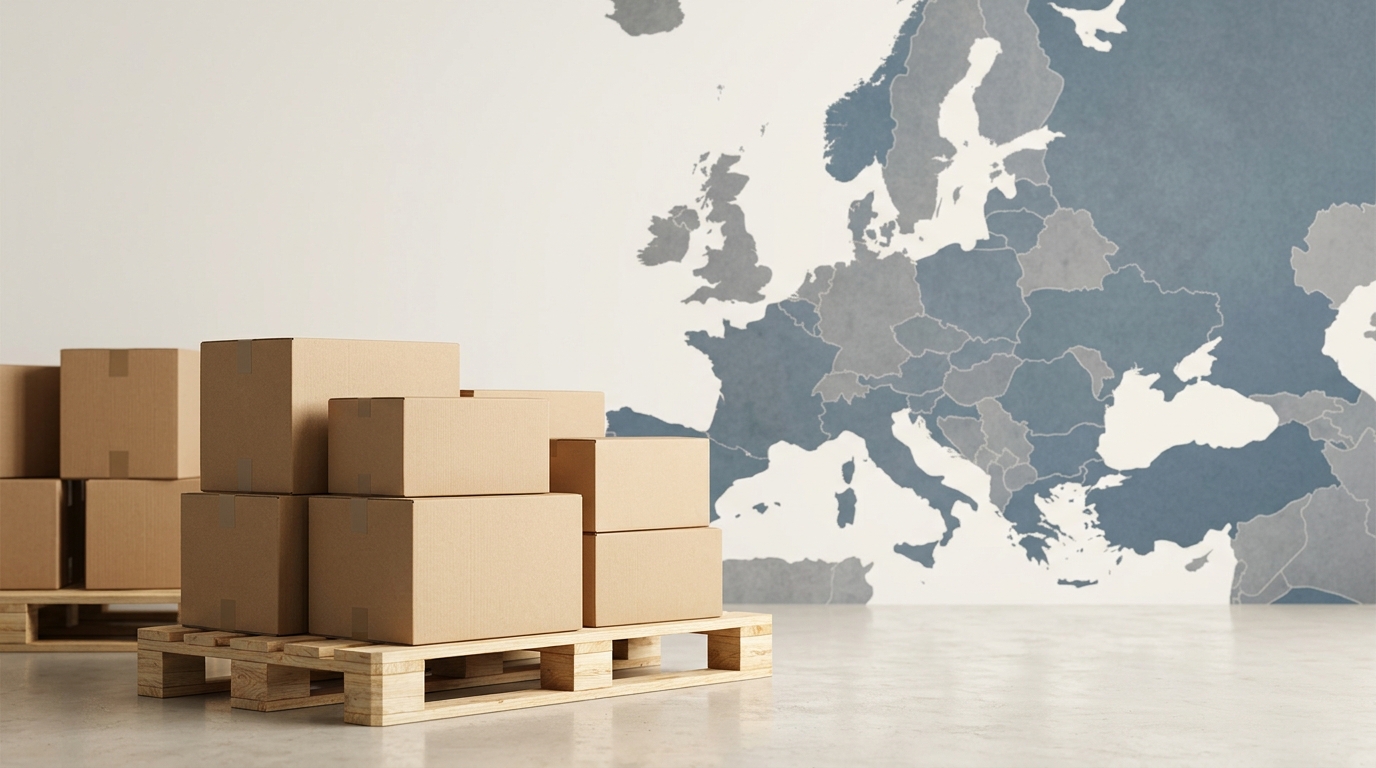
Multi-country budgets need country-specific assumptions
There is no EU-wide packaging licence or single price. Registers, schemes and rates remain national. Your budget therefore needs four cost categories for each destination country. Registration in one country does not replace registration in another.
- Scheme contributions, usually based on kilograms and material
- Registration in the producer register, where fees apply
- An authorised representative: generally a budget item for cross-border distance sales within the EU under current law; an EU procedure is examining a possible suspension for EU-based companies
- Internal administrative work for recording quantities, reporting and retaining evidence
Minimum or flat fees are fixed or quantity-independent budget items. For authorised representatives, the fee and billing model depend on the service contract. The scheme contribution depends on the quantity of packaging. Plastic illustrates how much rates differ. In 2026, Verpact charges €1.220 per kilogram excluding VAT for rigid plastic in the Netherlands.[1] ARA charges €1.040 per kilogram excluding VAT for household plastic packaging in Austria in 2026.[2] Material categories, minimum fees and exceptions are defined differently in each country.
Regulation (EU) 2025/40 on packaging (PPWR) entered into force on 11 February 2025 and has applied since 12 August 2026.[3] It regulates extended producer responsibility across the EU but does not create an EU-wide licence or uniform rate. Schemes and organisations in each Member State continue to set contributions. In Germany, the Packaging Law Implementation Act (VerpackDG) of 13 July 2026 has supplemented the PPWR since 12 August 2026.[4]
First, clarify your role in the destination country
Your role determines which costs apply to you. Under the PPWR, the producer is the party that first makes packaging available in a Member State.[3] Check this for each destination country and packaging type before entering amounts in your budget.
- The starting point is the producer role under the PPWR. However, national rules may still allow packaging obligations to be fulfilled by an upstream or downstream party (Vor- or Nachentpflichtung). In Austria, check and document who covers the relevant packaging quantities.[5]
- Direct sales from another EU Member State to end users: check the producer definition in Article 3(1)(15) PPWR. Under current law, Article 45(3) requires an authorised representative in the cases it covers. The Commission has proposed suspending this obligation for EU-established companies until 1 January 2035; the legislative procedure is ongoing.[3][6][7]
- Companies from third countries: check the producer role, delivery route and national rules in each destination country. The second sentence of Article 45(3) PPWR permits national requirements for authorised representatives. You therefore cannot assume an identical obligation throughout the EU. In Germany, Section 5(2) VerpackDG also requires the third-country producers it covers, without an establishment in Germany, to appoint a representative.[3][8]
- Sales to a trading partner in the destination country: who first makes the packaging available there depends on the delivery and contractual arrangements. Terms such as DDP or DAP, the role in importing the goods and the delivery route are indicators, but do not prove the position on their own.
- Reselling registered goods: the upstream supplier may be responsible for the product packaging. Additional shipping packaging that you use may still create obligations of your own.
The same packaging may require your own scheme participation in one country while falling under a trading partner’s responsibility in another. Keep delivery terms, contracts and quantity records for each destination country. If your business involves several countries and roles, you can request a ClearoSystems consultation.
Fixed and quantity-based cost items
Cost items fall into two groups. Fixed items apply regardless of quantity. Quantity-based items increase with each kilogram of packaging you place on the market in the destination country.
| Cost item | Type | Amount as at September 2026 |
|---|---|---|
| LUCID registration (Germany) | No cost | Free[9] |
| Scheme participation (Germany) | Quantity-based | Fee under your contract with the chosen scheme; no de minimis threshold[10] |
| ARA minimum fee (Austria) | Fixed item | €90 excluding VAT per year if the fees for the reported quantities fall below this amount[2][11] |
| ARA flat fee (Austria) | Fixed item, optional | €150 excluding VAT per year instead of quantity reporting, for up to 1,500 kg each of household and commercial packaging[2][11] |
| Material contributions in each destination country | Quantity-based | Rate per kilogram and material; for example, Verpact 2026: €0.017/kg for paper and cardboard, €1.220/kg for rigid plastic[1] |
| Authorised representative in the destination country | Contractual item, where required | Fee as quoted. Under current law, generally budget for this in cross-border distance sales within the EU. The EU procedure on a possible suspension for EU-based companies until 1 January 2035 is ongoing; no exemption is yet in force.[6][7] |
ARA’s minimum fee and flat fee are alternatives, not amounts to add together. If you report quantities, you pay at least €90 per year. If you choose the flat fee, you do not report quantities and pay €150 per year.[11]
Material rates apply only to the named operator and year. Verpact published its 2026 rates in September 2025. They remain largely stable but increase for beverage cartons and aluminium.[12] Never apply a rate to a different country or scheme.
The authorised representative is a separate cost item. Under Article 45(3) PPWR as currently in force, the producers it covers must appoint an authorised representative in the destination country when supplying end users directly from another EU Member State.[3] In COM(2025) 982, the Commission proposes suspending this obligation for EU-established companies until 1 January 2035. Procedure 2025/0395/COD is ongoing; the proposal is not an exemption in force.[6][7] Label this budget item as a cost under current law and check for changes before signing a contract.
For third-country companies, the specific obligation must also be checked against national rules. Germany requires an authorised representative for the producers covered by Section 5(2) VerpackDG without an establishment in Germany. The written authorisation must be in German, and the representative must be named to the Central Agency Packaging Register (ZSVR).[8] Producers remain responsible for their own LUCID registration.[13] The PPWR does not set the representative’s remuneration. Obtain a quotation for each destination country and separate one-off, recurring and any quantity-based service fees from scheme contributions.
Comparing the scale of costs in provider quotations
You can compare provider quotations only when both use the same role, scope and measured quantities. The 2026 scheme rates indicate the scale of contributions, not a market price for services.
| Material | Verpact (NL), 2026 rate, €/kg excluding VAT | ARA (AT), household packaging, 2026 rate, €/kg excluding VAT |
|---|---|---|
| Rigid plastic (Verpact: vormvast) / household plastic packaging | 1.220 | 1.040 |
| Flexible plastic | 1.320 | No separate household category |
| Aluminium | 0.340 | 0.480 |
| Beverage cartons | 0.920 | 1.020 |
| Glass | 0.100 | 0.108 |
| Paper and cardboard | 0.017 | 0.208 |
Sources: Verpact 2026 rates[1] and the ARA 2026 rate sheet, valid from 1 January 2026.[2]
Three conditions change how these figures apply in individual cases:
- The Netherlands: registration, the annual declaration (Aangifte) and the waste management contribution (Afvalbeheerbijdrage) apply only when you place more than 50,000 kg of packaging on the Dutch market per calendar year. Below the threshold, document how you calculated your quantities.[14][15] The threshold does not apply to single-use plastic (SUP) packaging or deposit packaging. In 2026, SUP packaging such as beverage cups or certain food containers attracts a surcharge of €2.100 per 1,000 units excluding VAT, in addition to the material rate.[1][14] Through differentiated rates, Verpact grants total discounts of up to €0.60 per kilogram for readily recyclable plastic packaging.[1]
- Austria: ARA distinguishes household and commercial packaging under Section 13h of the Waste Management Act 2002 (AWG 2002).[16][2] Commercial rates are significantly lower in 2026, for example €0.070 per kilogram for paper and €0.180 for film.[2] Section 9 of the Packaging Ordinance 2014 allows flat-fee arrangements for small quantities. ARA’s flat fee is one such option, not an exemption.[17][11]
- Germany: LUCID registration is free.[9] There is no de minimis threshold for small packaging quantities in commercial activities. Packaging subject to system participation must be covered by a scheme before it is made available.[10][18]
Verpact and ARA rates indicate the scale of a country budget; they are not a basis for calculating costs in other countries or with other providers. Compare quotations only for the same role, since that role determines whether a contribution is due.
Worked example for a Dutch online retailer
Hypothetical example: a retailer based in the Netherlands, with no establishment in Germany or Austria, sells directly to private consumers in all three countries. It records the following annual packaging quantities separately for each sales market. These are ordinary cardboard and plastic packaging only, with no SUP or deposit packaging and no quantities demonstrably already covered by other parties.
| Sales market | Cardboard per year | Plastic per year |
|---|---|---|
| The Netherlands | 1,000 kg | 100 kg |
| Germany | 800 kg | 80 kg |
| Austria | 400 kg | 40 kg |
These quantities are assumptions for the calculation, not customer data. The example assumes household packaging classification in Austria and a system participation obligation in Germany. It shows a full year at 2026 rates, not an invoice for entering a market partway through the year. All amounts below exclude VAT.
- The Netherlands: 1,000 kg + 100 kg = 1,100 kg on the Dutch market. This is below 50,000 kg, so the regular Verpact contribution for this ordinary packaging is €0 under current rules. The quantity calculation must still be documented. Quantities supplied to Germany and Austria are recorded separately and are not treated as Dutch domestic sales. SUP and deposit packaging would require a separate assessment.[14][15]
- Germany: LUCID registration costs €0. Request a scheme participation quotation for 800 kg of paper/cardboard and 80 kg of plastic. If the quotation uses kilogram rates, calculate 800 × the paper rate + 80 × the plastic rate; account for minimum or base fees according to the contract. Add a quotation for the authorised representative costs applicable to this scenario under current law, plus administrative work. No German scheme price is assumed here.[9][10][13]
- Austria: using ARA’s household rates, 400 kg × €0.208 + 40 kg × €1.040 = €83.20 + €41.60 = €124.80 per year. This exceeds the €90 minimum, so the minimum is not added. At 440 kg of household packaging, the example also qualifies for the €150 flat fee, which is €25.20 higher. To opt out of the flat fee, notify ARA and obtain confirmation. The work involved in reporting quantities may offset the saving. Add the authorised representative costs applicable to this scenario under current law.[2][11]
With quantity-based billing confirmed, the annual budget is: €0 Verpact + the German scheme quotation + €124.80 ARA + authorised representative costs for Germany and Austria + internal administrative costs. If you choose the ARA flat fee, €150 replaces €124.80. A reliable total is only possible once the required quotations are available.
Authorised representative costs in this example reflect current law. Only account for a possible suspension once it has taken effect and any remaining national obligations have been checked.[6][7]
Country budgets in four steps
- Which countries do I sell to? Create a separate budget row for every sales market, including your home market.
- What role do I have there? Clarify the producer role, delivery route, authorised representation and documented fulfilment of packaging obligations by upstream or downstream parties.
- Which packaging types and quantities do I place on the market? Record kilograms by country and material, plus unit counts where special rules require them.
- What fixed and variable costs follow? Calculate quantity × rate, treat minimum fees or flat fees as alternatives, and add service provider fees and administrative work. Record the rate year and pending legal changes.
A useful budget starts with the obligations that apply to your specific business, then adds rates and quotations. ClearoSystems helps establish which roles and obligations are relevant to your sales markets.
Outlook: what remains uncertain
The PPWR and Germany’s VerpackDG have applied since 12 August 2026.[3][4] Open issues include national amendments in the Netherlands and Austria, the EU rules on authorised representatives, and 2027 rates.
- The Netherlands: the 50,000 kg threshold currently remains in place. Verpact expects it to end following implementation of the PPWR.[19] A dated amendment to the Dutch Packaging Management Decree 2014 (Besluit beheer verpakkingen 2014) is not yet available.[20]
- Austria: the ministry has announced amendments to the AWG and the Packaging Ordinance, but they have not yet been adopted.[21][16] ARA expects changes to its rate structure no earlier than 2028.[5]
- Authorised representatives: COM(2025) 982 proposes suspending the obligation for EU-established companies until 1 January 2035. The legislative procedure is ongoing.[6][7] Until the law changes, budget using current law and the relevant national rules. Do not deduct hoped-for relief in advance.[3]
- 2027 rates: Verpact presented rate ranges on 7 July 2026; final rates had not yet been published as at 23 September 2026.[22][1] ARA has so far published only its 2026 rates.[23]
EPR contributions continue to apply. Enter 2027 rates in your budget only when the relevant rate sheets are available. Until then, use 2026 rates and flag the budget for annual review.
This article provides general guidance and does not replace a review of your specific circumstances. If you need to clarify your role and the relevant costs across several markets, request a ClearoSystems consultation. ClearoSystems supports the assessment of roles, registration and reporting obligations.
Frequently asked questions
- Is there a packaging licence that covers all EU countries?
- No. Each country has its own registers and schemes, and the PPWR does not create an EU-wide licence. Producers supplying end users directly from another Member State must appoint an authorised representative for extended producer responsibility there through a written mandate under Article 45(3) PPWR. The proposed suspension for EU-based companies until 1 January 2035 has not yet been adopted. A LUCID registration number applies only to Germany.
- In which countries do small quantities mean no packaging contribution?
- Of the countries covered here, only the Netherlands. Under current law, below 50,000 kg of packaging per calendar year, neither the Afvalbeheerbijdrage nor registration applies, except for SUP and deposit packaging. In Germany, LUCID registration is free, but there is no de minimis threshold for scheme participation. In Austria, ARA charges at least €90 per year, or you can choose the €150 annual flat fee for small quantities; both amounts exclude VAT.
- Are authorised representative fees set by law?
- No. Article 45(3) PPWR requires a written mandate but does not set remuneration. You agree the fee with the service provider. First check the obligation in the destination country, then the quotation’s one-off and recurring fees. A suspension for EU-based companies until 1 January 2035 has been proposed; until it takes effect, calculate costs under current law.
Sources
- [1]verpact.nl
- [2]ara.at
- [3]eur-lex.europa.eu
- [4]gesetze-im-internet.de
- [5]ara.at
- [6]eur-lex.europa.eu
- [7]eur-lex.europa.eu
- [8]gesetze-im-internet.de
- [9]verpackungsregister.org
- [10]verpackungsregister.org
- [11]ara.at
- [12]verpact.nl
- [13]verpackungsregister.org
- [14]zoek.officielebekendmakingen.nl
- [15]verpact.nl
- [16]ris.bka.gv.at
- [17]ris.bka.gv.at
- [18]gesetze-im-internet.de
- [19]verpact.nl
- [20]wetten.overheid.nl
- [21]bmluk.gv.at
- [22]verpact.nl
- [23]ara.at