At a glance
| Topic | As of 15 Oct 2026 |
|---|---|
| Legal basis | Elektro- und Elektronikgerätegesetz (ElektroG) of 20 Oct 2015, last amended by the act of 25 Nov 2025 (BGBl. 2025 I Nr. 286)[10] |
| EU basis | WEEE Directive 2012/19/EU of 4 Jul 2012, national producer registers in each member state[23] |
| Competent body | stiftung elektro-altgeräte register (stiftung ear), application in the ear portal[13] |
| Who registers | producers under § 3 Nr. 9 ElektroG, including importers and foreign distance sellers[1] |
| What is registered | every combination of brand and device type; one registration number per producer[20] |
| Proof | B2C: insolvency-proof guarantee; B2B: credible demonstration of use and take-back concept[2] |
| Official fees | €9.50 per brand and device type, €32.80 per registration number and started quarter[11] |
| Duration | usually 2 to 4 weeks if the application is complete[13] |
| Next date | new factors for the guarantee amount from 1 Jan 2027[18] |
What is the WEEE number?
The WEEE number is the registration number under the ElektroG. WEEE stands for Waste Electrical and Electronic Equipment. stiftung ear issues the number with the registration notice and publishes the producer in the directory of registered producers[13]. A valid number has eight digits and is stated as "WEEE-Reg.-Nr. DE" followed by the eight digits[20].
A producer has only one registration number but can hold several registrations under it: one per brand and device type[20]. A device type groups equipment of one category that is comparable in use or function[1]. So you never register a single model, a series or a product type[20].
The number applies only to Germany. Every EU member state keeps its own producer register[23]. What else the law requires, from take-back in retail to labelling, is explained in our guide to the ElektroG.
Who needs a WEEE number – and who does not?
You need your own number if the ElektroG classifies you as a producer. The term is wider than in everyday language: a producer is not only someone who builds equipment[1].
| Your situation | Own WEEE number? | Reason |
|---|---|---|
| You have equipment manufactured and offer it under your brand in Germany | yes | § 3 Nr. 9 Buchst. a ElektroG[1] |
| You offer other producers' equipment under your own brand | yes, unless the producer's name or brand appears on the equipment | § 3 Nr. 9 Buchst. b ElektroG[1] |
| You are the first to offer equipment from another EU country or a third country in Germany | yes | § 3 Nr. 9 Buchst. c ElektroG[1] |
| You are based abroad and sell online directly to end users in Germany | yes, through an authorised representative | § 3 Nr. 9 Buchst. d, § 8 Abs. 2 ElektroG[1][4] |
| You buy all equipment from producers registered in Germany and resell it | no, you state your supplier's number | distributor, not a producer[20] |
| You offer equipment from unregistered producers | yes, you are then deemed a producer yourself | § 3 Nr. 9 letzter Halbsatz ElektroG[1] |
| You sell used equipment that you bring into Germany from abroad for the first time | yes | stiftung ear[20] |
Company size plays no role. § 6 ElektroG links registration to placing on the market, not to a quantity[2]. Small producers can only have individual fees reduced on application; the quarterly fee is not one of them[12].
Foreign brand producers who sell through an importer in Germany must also appoint an authorised representative under § 8 Abs. 1 ElektroG. As long as they do not, the importer in Germany bears the producer obligations[4]. Delivery terms, invoice or storage location alone do not settle the role. What counts is who first offers the equipment in Germany.
Device type and brand: what the registration covers
stiftung ear distinguishes nine device types for equipment that private households can use (B2C) and eight for exclusively commercial use (B2B)[14]. They include heat exchangers, screen equipment, lamps, large equipment, small equipment, small IT and telecommunications equipment, and large and small photovoltaic modules[14]. If you cannot determine the right device type with certainty, use stiftung ear's classification tool[14].
- B2C or B2B: Equipment that both private households and other users can use counts as equipment from private households[1]. A B2B registration only fits if you can credibly demonstrate exclusively commercial use[3].
- Several device types: If you are registered only for "large equipment that can be used in private households" but also sell equipment under 50 cm, you need a further registration[20].
- Brand: The company name is permitted; a registered trade mark is not required. Not permitted are "no brand", "no name", pure type designations, equipment descriptions or the WEEE number itself[13].
- Spelling: Different spellings or type designations do not trigger a new registration; the "lowest common denominator" of the brand is sufficient[20].
WEEE registration with stiftung ear step by step
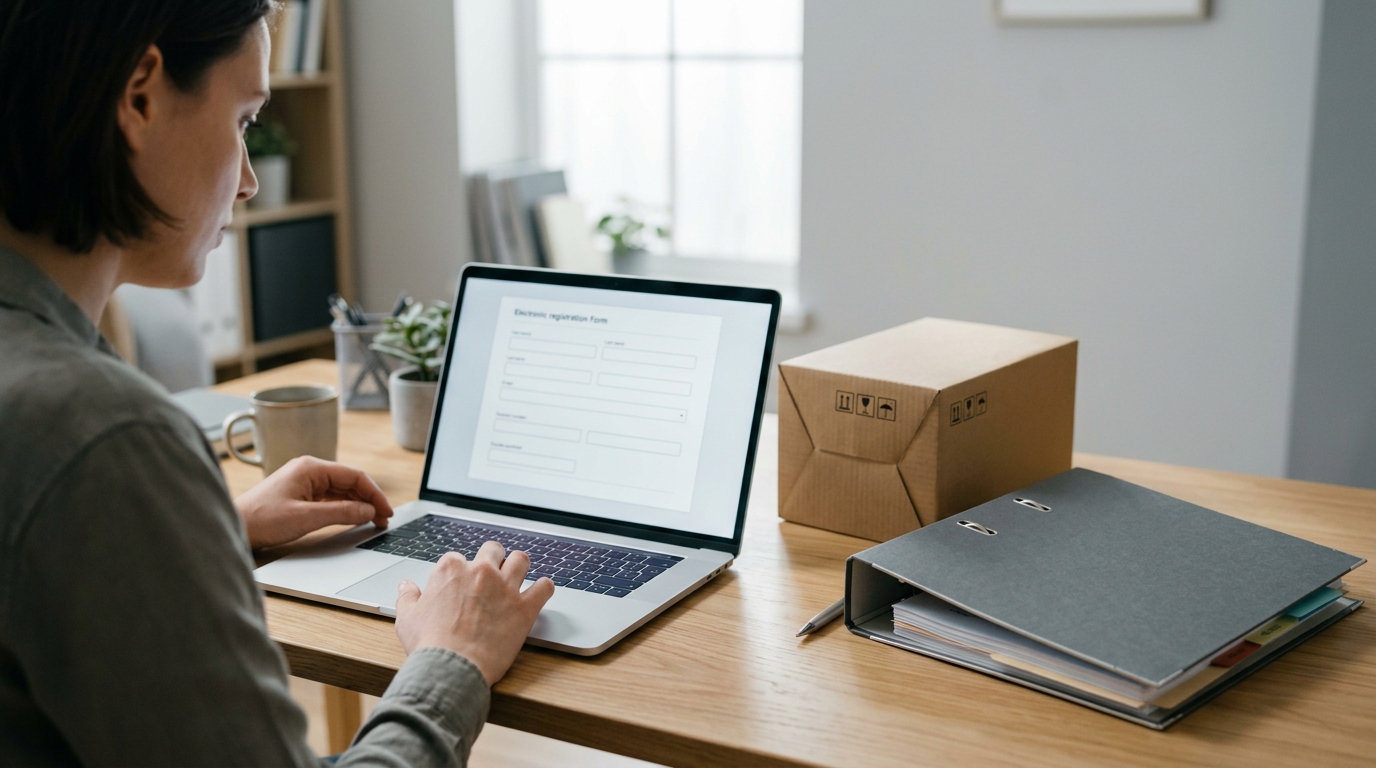
Prepare the details required by Anlage 2 (Annex 2) ElektroG in advance. They include company data with tax number, the person authorised to represent the company, a contact person, category and device type, type of use, brand, details of the guarantee or take-back concept and your sales method[9]. If you sell by distance selling to other EU countries, the list of those countries and the names of the authorised representatives there are also required[9].
- Create a user account in the ear portal, as a producer or authorised representative, and confirm the email address within seven days. An account alone is not yet a registration[13].
- Enter the person authorised to represent the company and the payment details in the portal[13].
- Without an establishment in Germany: appoint an authorised representative in writing and in German, for at least three months and only one for all brands and device types. stiftung ear first confirms this appointment[4][15].
- Submit the registration application per brand and device type[13].
- For B2C device types, provide proof of the guarantee; for B2B device types, attach the credible demonstration of use and the take-back concept[2][13].
- Submit the application, which is subject to a fee. stiftung ear processes applications in the order received; they cannot be brought forward[13].
- Receive the registration notice by email. It contains the WEEE-Reg.-Nr. DE, and the producer appears in the public directory. Only now may you place the equipment on the market[13][20].
If the application is complete and correct, stiftung ear expects two to four weeks; a high volume of applications or complex cases extend processing[13]. What determines the duration in detail is shown in our article How long does registration with stiftung ear take?.
Guarantee or credible demonstration: B2C and B2B
For equipment that private households can use, § 7 ElektroG requires an insolvency-proof guarantee. It secures the financing of later disposal and has nothing to do with the product warranty[3][13]. Permitted are a surety or first-demand guarantee from a credit institution or credit insurer, a cash deposit or participation in a suitable guarantee scheme[3].
You provide the proof for each calendar year[3]. stiftung ear determines the guarantee amount with a guarantee calculator; new factors apply from 1 January 2027[17][18]. If the guarantee is insufficient, stiftung ear first sends a reminder. If the proof is not provided, it can revoke the registration[7][17].
For equipment that is exclusively or usually not used in private households, the guarantee does not apply. Instead, you credibly demonstrate this use and submit a take-back concept[2][3].
What does the WEEE number cost?
The official fees are set out in the fee schedule of the ElektroGBattDGGebV, last amended on 30 Sep 2025[11][12]. They are net amounts; VAT is added where the service is taxable[12][16].
| Fee (no. in the fee schedule) | Amount | When charged |
|---|---|---|
| Registration per brand and device type (1.1) | €9.50 | once per registration[11] |
| Quarterly fee per registration number (1.2) | €32.80 | per started calendar quarter[11] |
| Review of a producer-specific guarantee (1.4) | €156.90 | per guarantee submitted[11] |
| Review of the guarantee amount (1.5) | €3.80 | per device type and started calendar year[11] |
| Review of B2B credible demonstration and take-back concept (1.6) | €18.90 | per registration[11] |
| Confirmation of the appointment of an authorised representative (1.7) | €50.60 | per appointment or change[11] |
| Change of the registered device type (1.10) | €20.50 | per change[11] |
A sample calculation with assumed data: a producer based in Germany registers one brand in two B2C device types and uses a guarantee scheme. One-off costs are 2 × €9.50 = €19.00. Each year, 4 × €32.80 = €131.20 in quarterly fees and 2 × €3.80 = €7.60 for the guarantee amount review are added, €138.80 in total. In the first full year, the producer therefore pays stiftung ear €157.80[11]. The quarterly fee is charged per registration number, not per device type; stiftung ear calculates it this way in its examples too[16].
Not included are the fee of the guarantee scheme or the bank charges for a surety, the costs of collecting and disposing of the waste equipment, and internal effort. A foreign producer also pays €50.60 for the confirmation of the authorised representative[11] plus the representative's fee, which varies by provider.
Obligations after registration
With the number, the ongoing producer obligations begin. The most important at a glance:
| Obligation | What to do | Basis |
|---|---|---|
| State the number | when offering equipment and on invoices[2] | § 6 Abs. 3 ElektroG |
| Label equipment | producer clearly identifiable, date of placing on the market, crossed-out wheeled bin symbol[5] | § 9 ElektroG |
| Report quantities | per device type monthly by the 15th of the following month; without a guarantee obligation (B2B) annually by 30 April; report zero quantities as zero[6] | § 27 ElektroG |
| Guarantee | provide proof for B2C equipment every calendar year[3] | § 7 ElektroG |
| Collect waste equipment | collect full containers at municipal collection points after allocation by stiftung ear (B2C)[19] | ElektroG |
| Take back | take back B2B equipment when it becomes waste[19] | ElektroG |
| Inform | inform customers about return, deletion of personal data and the symbol[19] | ElektroG |
| Report changes | notify changed data and the cessation of placing on the market without delay[2] | § 6 Abs. 1 ElektroG |
Producers may not show disposal costs separately to end customers[3].
Marketplaces and fulfilment: how the number is checked
Since 1 July 2023, operators of online marketplaces and fulfilment service providers must check whether their customers are correctly registered with stiftung ear[21]. If a producer is not registered, marketplaces may not enable the offering of its equipment. Fulfilment service providers may not store, package, address or ship it[2].
If a marketplace rejects your number, first check whether your registration covers the brand and device type offered[20]. If you are only a reseller, state your supplier's number; an unnecessary registration of your own should be avoided[20]. Every number can be checked in the public directory of registered producers and authorised representatives[22]. Which proof Amazon requires for electrical equipment, batteries and packaging is shown in our article on EPR proof for Amazon.de.
Consequences of missing registration
Without proper registration, a producer may not place its equipment on the market. The same ban applies to distributors, marketplaces and fulfilment service providers with regard to this equipment (§ 6 Abs. 2 ElektroG)[2]. A distributor that offers equipment from unregistered producers is itself deemed a producer[1].
Missing or late registration, placing on the market without registration, a missing number in the offer, failure to appoint an authorised representative and incorrect quantity reports are administrative offences under § 45 ElektroG[8]. If the guarantee or the take-back concept is missing, stiftung ear can revoke the registration[7].
Common mistakes
- Account created, application not submitted: a producer account without a registration application is not a registration[20].
- Wrong device type: small equipment is not covered by a large-equipment registration; register every device type you actually sell[20].
- Missing brand: further own brands need their own registrations[20].
- B2B chosen although private use is possible: such equipment counts as household equipment and needs a guarantee[1].
- Selling before the notice: only the registration notice permits placing on the market[13].
- Own number despite a pure reseller role: state the number of the registered supplier instead[20].
- Guarantee not renewed: the proof is valid per calendar year[3].
For companies from the Netherlands, Austria and Switzerland
If you have no establishment in Germany, you need an authorised representative based in Germany for the WEEE registration. This applies to brand producers, importers and online retailers that sell directly to end users in Germany[4]. The authorised representative is registered with a separate registration number for each producer it represents[7] and appears in the directory on your behalf[15].
A registration in your home country does not cover Germany, because every EU country keeps its own register[23]:
- Netherlands: producers and importers join Stichting OPEN; OPEN registers them in the Nationaal (W)EEE Register[25][26].
- Austria: foreign distance sellers must in turn appoint an authorised representative there; the mandate and registration are handled through the EDM portal[24].
- Switzerland: there is no WEEE registration on the EU model. Retailers, producers and importers must take back waste equipment free of charge under the VREG; this is financed through the advance recycling fee of SENS and Swico[27].
Conversely: a producer based in Germany that sells by distance selling directly to end users in another EU country must appoint an authorised representative there[4]. How to organise such obligations by target country is shown in the overview of EPR obligations in other EU countries and the guide to extended producer responsibility.
Status and changes
As of 16 October 2026. We reviewed the ElektroG as amended on 25 November 2025, the fee schedule of the ElektroGBattDGGebV, the guides and notices of stiftung ear including the guarantee amount factors from 1 January 2027, and the WEEE Directive 2012/19/EU. We will review this page again when the new guarantee factors apply or the fee schedule changes. Changes: 15 October 2026, first version; 16 October 2026, technical clarifications after expert review (authorised representative in the introduction). In the needs analysis, ClearoSystems clarifies role, device type and target countries and, if required, takes over registration, reports and the appointment of an authorised representative. Translated from the German version of 16 October 2026.
Frequently asked questions
- How can I check a WEEE number?
- In the public directory of registered producers and authorised representatives that stiftung ear provides online. A producer counts as registered as soon as it appears there with number, brand, company name, category and device type. Before purchasing, check whether your supplier's brand and device type match the goods you buy, and document the result with the date.
- Do I need a WEEE number as a small business?
- Yes, if you are a producer within the meaning of the ElektroG; there is no minimum quantity. Relief exists only for fees: registration and review fees can be reduced on application if they are disproportionate in relation to quantity, value and relevance for disposal. You submit the application within three months of the fee notice. No reduction is provided for the quarterly fee.
- Does the WEEE number also cover the rechargeable batteries in my equipment?
- No. Batteries and rechargeable batteries need a separate registration with stiftung ear under the Batterierecht-Durchführungsgesetz (BattDG, the German Battery Act), per brand and battery category. You receive a separate battery registration number for this. An electrical device with a built-in rechargeable battery in a shipping package therefore touches three areas of obligation: device, battery and packaging.
- Is my German WEEE number also valid in Austria or the Netherlands?
- No. Registration with stiftung ear applies only to Germany. If you sell directly to end users in another EU country, you need the national registration there and usually a local authorised representative. You also state these countries and authorised representatives in your German registration.
- Do I need to register again if I introduce a new brand?
- Yes, for every new brand you apply for a further registration per device type before the first offer; your registration number stays the same. If, on the other hand, only the company name, legal form or address changes, report the change with supporting documents in the ear portal. stiftung ear then checks whether the number remains.
- May I show the disposal costs on the invoice?
- No. Producers may not show the costs of disposing of the equipment separately to the end customer. Your WEEE registration number, on the other hand, must appear on offers and invoices.
Sources
- [1]§ 3 ElektroG: Begriffsbestimmungen (Hersteller, Geräteart, Bevollmächtigter) (accessed 15 Oct 2026)
- [2]§ 6 ElektroG: Registrierung und Vertriebsverbote (accessed 15 Oct 2026)
- [3]§ 7 ElektroG: Finanzierungsgarantie (accessed 15 Oct 2026)
- [4]§ 8 ElektroG: Niederlassungspflicht und Bevollmächtigter (accessed 15 Oct 2026)
- [5]§ 9 ElektroG: Kennzeichnung (accessed 15 Oct 2026)
- [6]§ 27 ElektroG: Mitteilungspflichten der Hersteller (accessed 15 Oct 2026)
- [7]§ 37 ElektroG: Aufgaben der zuständigen Behörde bei der Registrierung (accessed 15 Oct 2026)
- [8]§ 45 ElektroG: Bußgeldvorschriften (accessed 15 Oct 2026)
- [9]Anlage 2 ElektroG: Angaben bei der Registrierung (accessed 15 Oct 2026)
- [10]ElektroG: Gesamtausgabe mit Stand der letzten Änderung (accessed 15 Oct 2026)
- [11]ElektroGBattDGGebV: Gebührenverzeichnis (accessed 15 Oct 2026)
- [12]ElektroGBattDGGebV: Gebührenerhebung und Gebührenermäßigung (§§ 1–2) (accessed 15 Oct 2026)
- [13]stiftung ear: WEEE-Registrierung beantragen (accessed 15 Oct 2026)
- [14]stiftung ear: Welche Gerätearten gibt es, und wozu gehört mein Gerät? (accessed 15 Oct 2026)
- [15]stiftung ear: WEEE-Nummer beantragen als ausländisches Unternehmen (accessed 15 Oct 2026)
- [16]stiftung ear: Kosten und Gebühren mit Rechenbeispielen (accessed 15 Oct 2026)
- [17]stiftung ear: Garantien kennenlernen (accessed 15 Oct 2026)
- [18]stiftung ear: Neue Garantiebetragsfaktoren ab 01.01.2027, Mitteilung vom 01.09.2026 (accessed 15 Oct 2026)
- [19]stiftung ear: Welche Pflichten haben Hersteller von Elektrogeräten? (accessed 15 Oct 2026)
- [20]stiftung ear: Die 10 wichtigsten Fragen von Marktplatzverkäufern, Stand 06/2023 (accessed 15 Oct 2026)
- [21]stiftung ear: INFObrief 3/2024, Ein Jahr Prüfpflicht für Online-Marktplätze und Fulfilment-Dienstleister (accessed 15 Oct 2026)
- [22]stiftung ear: Verzeichnisse der registrierten Hersteller und Bevollmächtigten (accessed 15 Oct 2026)
- [23]Richtlinie 2012/19/EU über Elektro- und Elektronik-Altgeräte, Art. 16 und 17 (accessed 15 Oct 2026)
- [24]Unternehmensserviceportal Österreich: Bevollmächtigte für Elektro- und Elektronikgeräte (accessed 15 Oct 2026)
- [25]Nationaal (W)EEE Register: Registrierung von Herstellern in den Niederlanden (accessed 15 Oct 2026)
- [26]Stichting OPEN: Herstellerverantwortung für Elektrogeräte und Batterien in den Niederlanden (accessed 15 Oct 2026)
- [27]BAFU: Elektrische und elektronische Geräte (accessed 15 Oct 2026)