The manufacturer issues the declaration of conformity
The PPWR declaration of conformity is issued by the manufacturer of the packaging[1]. The manufacturer is not only whoever physically makes the packaging, but also whoever has it made under their own name or trademark. For a retailer that fills purchased, unprinted standard boxes, this is usually the box maker. If the boxes carry the retailer's name or brand, the retailer is usually the manufacturer.
Regulation (EU) 2025/40 distinguishes between two terms that are easily confused. The manufacturer under Art. 3(1)(13) is responsible for the conformity of the packaging, and there is only one manufacturer in a supply chain[2]. The producer under Art. 3(1)(15), by contrast, is the role in extended producer responsibility (EPR), meaning registration and fees.
The regulation entered into force on 11 February 2025 and has applied since 12 August 2026. Before placing packaging on the market, the manufacturer carries out the conformity assessment under Article 38 or has it carried out. It draws up the technical documentation under Annex VII and keeps it. Under Art. 15(2) and Article 39, it issues the EU declaration of conformity for each packaging type, following the model in Annex VIII, and thereby takes responsibility for conformity[1].
Which case applies to you?
Whether you issue the declaration yourself or only check it depends on where your packaging comes from and under whose name it is placed on the market:
- Own packaging or own brand: if you make the packaging yourself or have it made under your name or brand, check whether you are the manufacturer. If you are, you draw up the technical documentation and the declaration yourself.
- Import from a non-EU country: if you are the first to place packaging or packaged products from a non-EU country on the EU market, you have importer obligations. You check that the manufacturer has carried out the conformity assessment, put your name and address on the packaging and keep a copy of the declaration available. If you import goods under your own brand, the first case applies.
- Resale of goods from an EU supplier: if you resell goods unchanged and without your own brand, your obligations are mainly those of a distributor. You check registration, labelling and the details of the manufacturer or importer. The regulation does not expressly require you to request the declaration from your supplier, but doing so is good practice.
With own brands, imports or more complex supply chains, the allocation of roles can differ from the standard case and should be checked more closely. This affects many online retailers. In that case, request a ClearoSystems consultation: our experts determine the role that applies and the next steps for your packaging. For background on roles and destination countries, see our article on EPR obligations in other EU countries.
Standard boxes and own-brand packaging
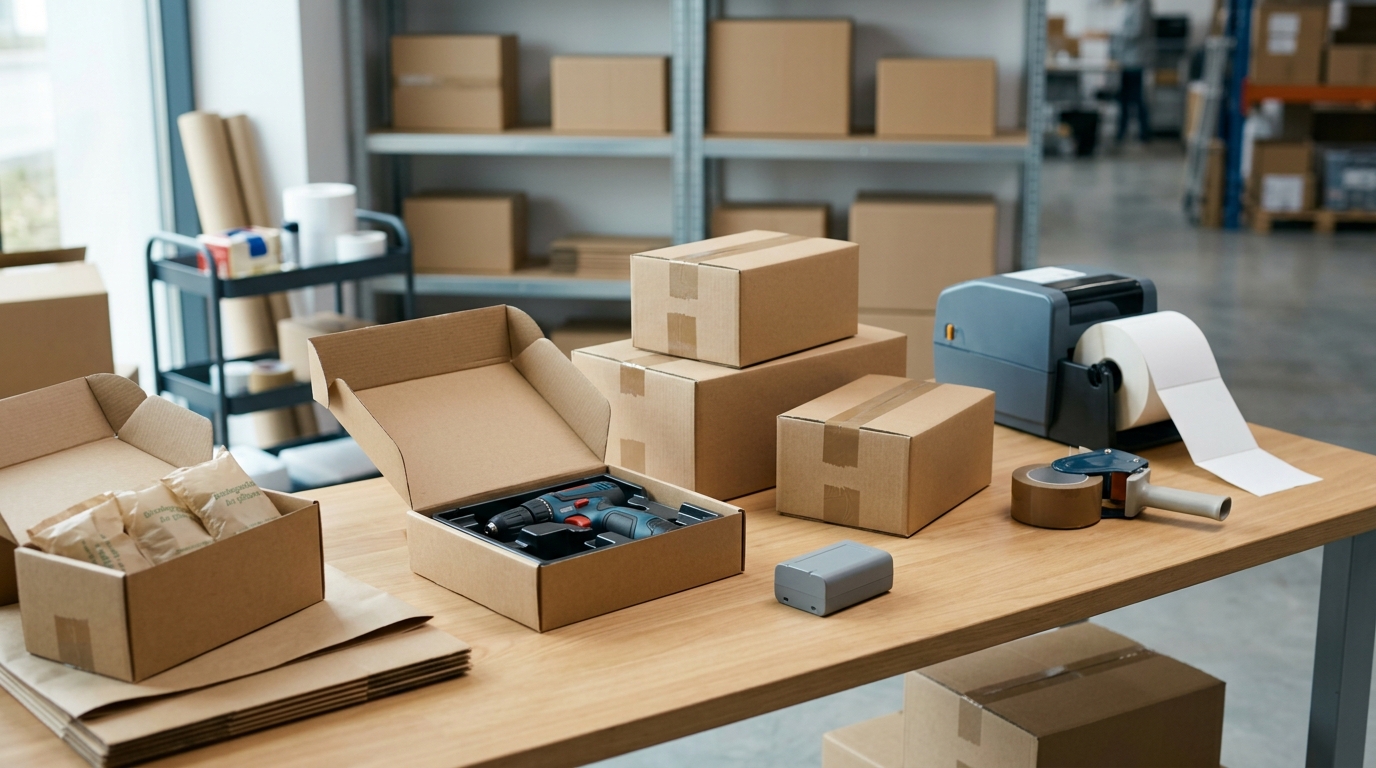
For unprinted standard shipping boxes, the Commission's FAQ say the manufacturer is usually the company that physically makes the boxes. A sticker added for shipping does not count as branding[3]. Where packaging carries no name and no brand, the FAQ point to whoever orders it and determines its design specifications. If you only fill and ship such boxes, you do not issue a declaration of your own. It is still sensible to request the box maker's declaration and file it.
Own-brand packaging is different: if you have packaging or packaged products made with your name or brand, you are the manufacturer under Art. 3(1)(13)(a). According to the Commission's FAQ, this also applies if you simply choose a standard pack from your contract packaging supplier and have nothing changed[3]. The consequence: you carry out the conformity assessment, draw up the technical documentation and issue the declaration in your own name. Your supplier must provide you with all the information and documents you need for this.
| Aspect | Unprinted standard shipping box | Own-brand packaging |
|---|---|---|
| Manufacturer role | Usually the box maker | You (Art. 3(1)(13)(a)), unless the micro-enterprise rule applies |
| Technical documentation (Annex VII) | Drawn up by the box maker | Drawn up by you, with documents from your supplier |
| Declaration of conformity (Annex VIII) | Issued by the box maker | Issued by you in your own name |
| Your task | Due diligence as a distributor; requesting the supplier's declaration is recommended | Take responsibility for the conformity assessment and the declaration |
| Retention | Details of your suppliers for 5 years (single-use) or 10 years (reusable) under Art. 22(2) | Documentation and declaration for 5 years (single-use) or 10 years (reusable) under Art. 15(3) |
PPWR roles: manufacturer, importer, distributor
If you fully outsource production and design, you are still the manufacturer as long as the packaging is placed on the market under your own name or brand. This applies regardless of whether other brands also appear on the packaging[1]. Under Article 21, importers and distributors become manufacturers if they place packaging on the market under their own name or brand. The same applies if they modify packaging already placed on the market in a way that may affect its conformity.
A special rule covers micro-enterprises, meaning companies with fewer than 10 employees and an annual turnover or balance sheet total of no more than EUR 2 million[2]. If a micro-enterprise has packaging made under its name or brand, the supplier of the packaging can count as the manufacturer, even if the supplier is not a micro-enterprise itself. The regulation is not consistent on where this supplier must be located. The definition in Art. 3(1)(13)(b) requires a supplier located in the same Member State. Art. 15(12), which applies to the manufacturer's obligations including the declaration of conformity, and Art. 21 instead refer to a supplier located in the Union[1]. The Commission's guidelines and FAQ assume the same Member State without addressing the different wording[2][3].
In practice, this means: if your supplier is located in the same Member State as your micro-enterprise, the regulation, the guidelines and the FAQ all agree that the rule applies. If the supplier is in another EU country, the position is not settled and should be checked case by case. If the supplier is outside the EU, the rule does not apply. The rule only shifts the manufacturer role: according to the Commission's FAQ, micro-enterprises are not generally exempt from extended producer responsibility obligations[3].
An importer is a company established in the EU that is the first to place packaging or packaged products from a non-EU country on the Union market. Importing alone does not make you the manufacturer[1].
| Role | Typical situation | Consequence for the declaration of conformity |
|---|---|---|
| Manufacturer | Makes packaging or has it made under its own name or brand | Carries out the conformity assessment, draws up the technical documentation under Annex VII and issues the declaration under Annex VIII |
| Supplier | Supplies packaging or packaging materials to the manufacturer | No declaration of its own; provides the manufacturer with the necessary information and documents. Exception: the micro-enterprise rule |
| Importer | Established in the EU, first to place goods from non-EU countries on the market | Checks the manufacturer's assessment and documentation and keeps a copy of the declaration available; becomes the manufacturer if it uses its own brand or modifies the packaging |
| Distributor | Resells without its own brand and without changes that affect conformity | No declaration of its own; due diligence obligations, in particular checking registration, labelling and the details of the manufacturer or importer |
| Authorised representative | Established in the EU, appointed in writing by the manufacturer | Takes on assigned tasks such as record keeping and contact with authorities; may not draw up the technical documentation, and responsibility stays with the manufacturer |
When the declaration is required
The declaration of conformity has been required since 12 August 2026 for packaging placed on the market from that date. It confirms the requirements of Articles 5 to 12 to the extent that they already apply at that point[1]. Further requirements will follow in stages, so the manufacturer keeps the declaration up to date. Packaging placed on the market before 12 August 2026 may continue to be sold[3].
Outlook: what is still being specified
This article reflects the text of Regulation (EU) 2025/40, the Commission's guidelines of 10 June 2026 and the Commission's FAQ of August 2026. Some technical details, such as harmonised standards and delegated acts, are still to come, so practical implementation will continue to develop. If the declaration is missing or incorrect, the authority first requires it to be corrected. If the non-compliance persists, the Member State takes appropriate measures to prohibit the packaging from being made available on the market or to have it recalled or withdrawn (Art. 62)[1].
To clarify your position now, request a ClearoSystems consultation. Our experts determine the role that applies and support implementation as the rules continue to develop. The page how ClearoSystems works describes the process from analysis to implementation.
Frequently asked questions
- Who issues the PPWR declaration of conformity for standard boxes?
- For unprinted standard shipping boxes, usually the box maker, because it is the manufacturer under Art. 3(1)(13) PPWR; a shipping sticker is not branding. If you have the boxes printed with your name or brand, you are the manufacturer yourself and must draw up the technical documentation under Annex VII and issue the declaration yourself. Simply importing boxes from a non-EU country makes you an importer, not the manufacturer.
- Can my own logo mean that I count as the manufacturer?
- It can. What matters is not the logo as such, but whether packaging is made or placed on the market under your own name or brand. If you have packaging made with your brand, you are the manufacturer under Art. 3(1)(13) PPWR. Importers and distributors who place packaging on the market under their own name or brand count as manufacturers under Article 21. A sticker you add only for shipping, on the other hand, does not count as branding. For micro-enterprises, the manufacturer role can lie with the supplier; the section on roles sets out the conditions.
- How long do I have to keep my supplier's declaration of conformity?
- That depends on your role. As an importer, you keep a copy of the declaration available for 5 years for single-use packaging and 10 years for reusable packaging after it is placed on the market. As a pure distributor, you have no express obligation to keep the declaration, but you must be able to provide details of your suppliers for 5 or 10 years after you received the packaging. Filing the declaration you received for the same period is advisable.