Why kilograms decide everything: your Verpact declaration
In the Netherlands, extended producer responsibility for packaging operates on a direct mass-based principle: every statutory obligation, threshold, and waste management contribution is measured in kilograms placed on the national market. Under the 2014 Packaging Management Decree (Besluit beheer verpakkingen 2014), companies that put packaged goods into commercial circulation are legally responsible for the waste stage of those materials[1]. To establish whether you owe financial contributions and detailed annual reporting, producer organisation Verpact evaluates your aggregate packaging volume across all material categories.
For standard taxable packaging, the waste management contribution and the annual declaration apply once you bring more than 50,000 kilograms of packaging onto the Dutch market in a calendar year, counted across all materials together[2]. Above that line, the first 50,000 kg are deducted pro rata per material, so the threshold works as an allowance rather than a cliff; below it, the declaration and the contribution fall away, though you must still maintain verifiable administration to prove you remain below the line. This volume threshold also does not apply across the board: Verpact states that there is no threshold for Single Use Plastic (SUP) packaging and deposit packaging, while the threshold of 50,000 kg applies to other taxable packaging, so SUP and deposit packaging must be declared from the very first unit[3]. Understanding which packaging falls under EPR is therefore the critical first step before calculating your annual mass.
| Packaging Category | Annual Threshold | Core Administrative Obligation |
|---|---|---|
| Standard primary & shipping packaging (paper, cardboard, glass, metals, standard plastics) | More than 50,000 kg per calendar year, across all materials together | At or below the threshold: no declaration and no contribution, administration remains; above it: declaration and contribution due, with the first 50,000 kg deducted pro rata per material |
| Single Use Plastic (SUP) and deposit packaging | No threshold | Mandatory declaration of material weight from unit one |
| Indirect export (packaged goods purchased in NL and exported abroad) | Refundable | Where the waste management contribution was paid earlier in the chain, you can request a refund for indirect export in your annual report; Verpact requires proof that the fee was paid further up the chain and supplier details with weights per material category |
When assessing your total volume, domestic sales must be cleanly separated from exported parcels. Where the waste management contribution was already paid earlier in the Dutch chain and you then export the packaged goods, you can request a refund of the contribution for indirect export in your annual report[2]. Verpact grants that refund only if you can prove the fee was paid further up the chain and your administration records the supplier's name, address and Chamber of Commerce details with the weights per material category[4]. Keep in mind that cross-border shipments trigger destination-country obligations: Germany, for example, keeps its own LUCID packaging register with no minimum threshold, governed since 12 August 2026 by the PPWR and the German VerpackDG, and requires separate registration and system participation.
Method 1: Weighing a representative sample of shipments
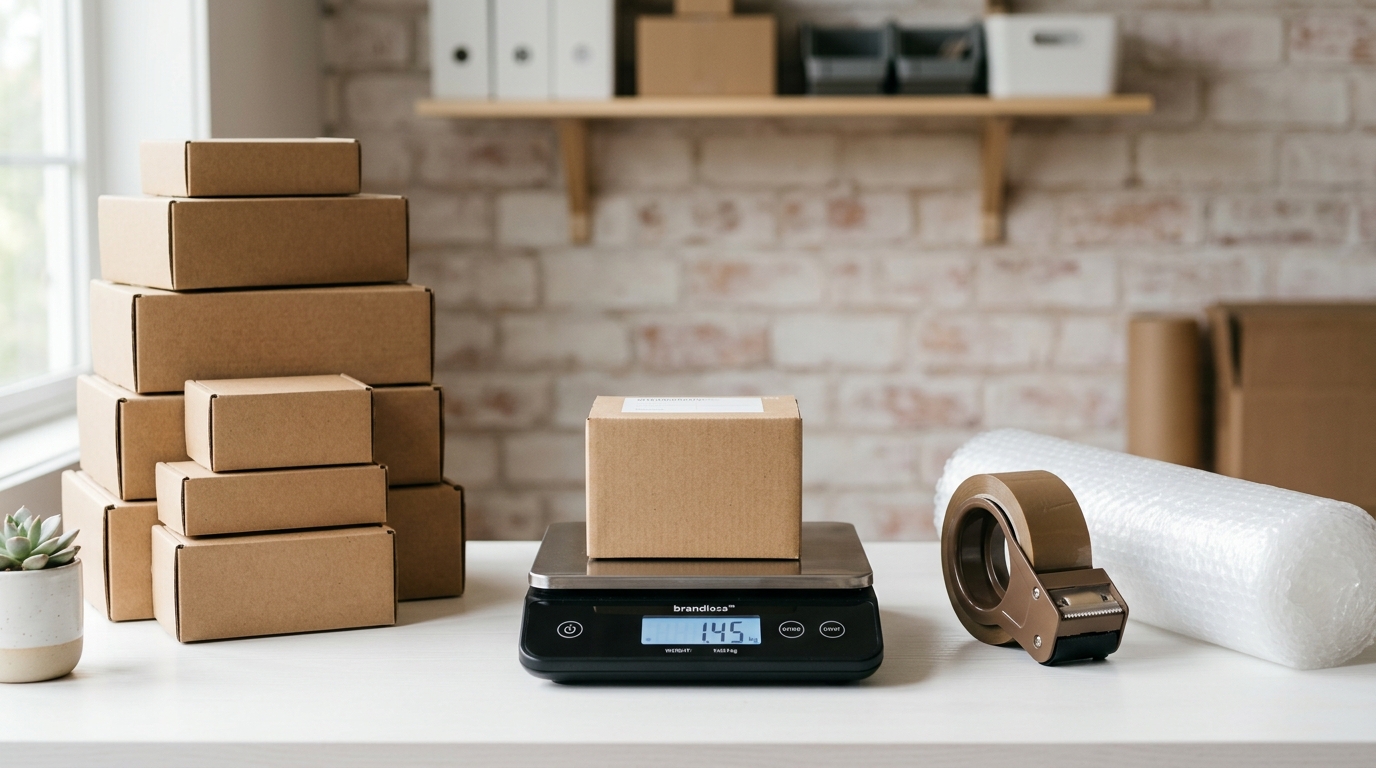
The most direct way to determine your packaging weight is physical measurement on a representative sample of dispatches. Rather than weighing every outgoing order throughout the year, you sample real parcels across your primary packaging formats. This hands-on method provides empirical ground truth, making it particularly effective for webshops shipping diverse, non-standardised product combinations where theoretical calculations can deviate from reality.
To establish a reliable baseline, you isolate empty packaging components: the outer shipping carton, void fill (such as kraft paper, air pillows, or bubble wrap), sealing tape, and shipping labels. Each component must be weighed individually on a calibrated scale and sorted into its material category (paper/cardboard, rigid plastic, flexible plastic, or mixed materials).
- Define your core shipping box formats: Group your parcel dispatch sizes into standard categories (for example: Small Letterbox Box, Medium Shipping Carton, and Large Multi-Item Box).
- Weigh all empty components per format: Measure the empty box, average infill weight per pack, length of adhesive tape, and label in grams, recording each material separately.
- Calculate average tare weight per format: Combine the component weights to establish a verified total gram weight per material stream for each parcel size.
- Sample across dispatch history: Review a representative time window (such as 100 to 500 dispatches over two typical trading weeks) to verify packaging material usage across order types.
- Extrapolate against annual order volumes: Multiply the average material weight per parcel format by the total number of parcels shipped in that format over the calendar year.
While sampling provides immediate clarity, you must document the sampling dates, sample sizes, and calculation formulas in your records. If product packaging varies significantly by season (such as during peak holiday promotions with extra protective materials), update the sample periodically to maintain accuracy.
Methods 2 and 3: Calculating from purchase data and SKU models
For e-commerce businesses managing structured catalogues or buying packaging in bulk batches, data-driven calculation methods offer continuous traceability. Instead of physical parcel sampling, these approaches derive weights from purchasing records or enterprise resource planning (ERP) product master data.
Method 2: Calculating from supplier purchase invoices
When you purchase shipping cartons, mailer bags, and filling materials directly from packaging distributors, your purchase invoices and supplier specifications serve as the primary source. Suppliers typically list the unit weight or square-metre grammage of cartons, tape rolls, and film. By taking your annual purchased quantities, subtracting physical ending inventory at year-end, and separating materials, you arrive at the net packaging consumed during the calendar year.
Relying on supplier statements alone is rarely sufficient without internal verification. Supplier spec sheets state nominal grammages that carry standard production tolerances, and master invoices do not automatically show how much packaging was used for domestic orders versus exported dispatches. Purchase figures should always be cross-checked against actual dispatch counts.
Method 3: The per-SKU packaging master model
In a per-SKU model, you assign a fixed packaging bill-of-materials (BOM) to each stock keeping unit in your catalogue. Each SKU profile stores the primary product packaging weight (such as a retail folding box, blister tray, or protective polybag) broken down by material. When a customer orders that SKU, your warehouse management system or sales reporting records both the item and its associated packaging mass.
| SKU Model Layer | Material Tracked | Calculation Step | Data Source |
|---|---|---|---|
| Primary / Product Packaging | Cardboard box, plastic inner tray, foil seal | Weight in grams per individual product unit | Product master data / item technical specifications |
| Secondary / Bundling Packaging | Shrink wrap, outer divider, shelf tray | Weight allocated proportionally across bundled units | Supplier packing slips / inbound goods intake sheets |
| Tertiary / Shipping Packaging | Corrugated master carton, paper tape, address label | Average shipping material divided across dispatched orders | Order management dispatch reports and carrier manifests |
Multiplying per-SKU packaging weights by your total annual sales volume creates a granular, automated dataset. This model scales seamlessly for growing webshops, ensuring every product line added to your shop is immediately captured in your annual packaging fee calculations.
Choosing your approach and documenting it for Verpact
Selecting the right measurement method depends on your order volume, catalogue depth, and warehouse structure. Smaller webshops with limited SKU counts often start with sample weighing (Method 1), whereas automated fulfillment setups and multi-channel retailers rely on SKU models (Method 3) or combined invoice balances (Method 2). In practice, many businesses use a hybrid model: SKU data for primary product packaging and purchase invoice reconciliation for shipping boxes and void fill.
- Log material categories cleanly: Record paper/cardboard, rigid plastic, flexible plastic, glass, ferrous metals, aluminium, and wood in separate columns.
- Retain underlying calculation files: Save your spreadsheet models, sampling logs, scale calibration notes, and ERP export reports alongside annual financial accounts.
- Archive supplier specifications: Keep technical datasheets from carton manufacturers and packaging suppliers detailing grammage, material purity, and recycled content.
- Document export deductions: Maintain shipping manifests and courier export reports showing foreign delivery addresses to justify deducted export volumes.
- Store data for at least seven years: Dutch businesses must keep their business records for at least 7 years, the mandatory retention period, and your packaging administration should stay just as accessible for inspection by Verpact or the Dutch Human Environment and Transport Inspectorate (ILT)[5].
Clear documentation is your primary defence during an audit. Under Dutch inspection protocols, the ILT and Verpact do not require perfection down to the single gram, but they require a consistent, verifiable methodology that accurately reflects your business operations. Following a structured packaging registration checklist ensures your administrative records remain defensible year after year.
Outlook: How the rules develop from here
The regulatory landscape governing packaging and packaging waste is undergoing significant structural reform at both European and national levels. The European Union has adopted the Packaging and Packaging Waste Regulation (EU) 2025/40 (PPWR), which entered into force on 11 February 2025 and has applied generally since 12 August 2026[6]. The PPWR introduces harmonised packaging design criteria, stricter recycled content targets, and expanded digital reporting requirements across all EU member states.
While European regulations establish the overarching framework, national obligations continue to be implemented through national instruments, and many administrative details remain in transition. For Dutch webshops, precise calculation of packaging kilograms will remain foundational, but how data is submitted and verified is expected to evolve as Dutch legislation adapts to the new European rules under the PPWR.
Which compliance obligations apply to your webshop depends on your exact role in the packaging chain. A merchant sourcing pre-packaged goods from a domestic Dutch distributor operates under different legal requirements than a business importing goods from outside the EU or manufacturing custom-branded packaging under its own label. These operational distinctions cannot reliably be resolved through a general checklist alone.
To understand your exact compliance position today and stay ahead of regulatory changes, start our Digital needs analysis. Our assessment evaluates your product portfolio, sales channels, and target markets to provide a clear, step-by-step roadmap for your packaging compliance.
Frequently asked questions
- Which scheme applies to what I sell?
- For packaging placed on the Dutch market, Verpact is the governing scheme. However, if you ship cross-border to consumers in Germany or other EU countries, those national schemes apply to the exported volumes. For example, Germany has its own registration requirements (LUCID) that run parallel to the Dutch framework.
- Who counts as the producer in my setup?
- You are generally considered the producer if you manufacture packaged goods in the Netherlands, import packaged products, or add packaging (like transport boxes) to items before selling them to Dutch consumers. Your exact role dictates your obligations and what you must record in your packing administration.
- How do I measure my packaging weight if I use a fulfilment centre?
- Even if a logistics provider packs your orders, you remain legally responsible for the packaging added on your behalf. You must coordinate with your fulfillment center to obtain accurate data on the materials and weight in kilos per category used for your shipments.
- Does logistics packaging count towards the 50,000 kg threshold?
- No, single-use logistics aids are excluded from the 50,000 kg threshold calculation, and no fee attaches to them. However, you must still declare their first placement on the Dutch market in your Verpact declaration, so you must track their weights alongside your primary and secondary packaging. Reusable logistics aids carry no declaration duty at all.
- Where do I start if none of this has been arranged yet?
- Start by identifying all the packaging materials you currently use and run a sample calculation to estimate your total annual weight. Because cross-border and role-specific rules complicate matters, using the Digital needs analysis will pinpoint exactly which obligations you need to tackle first.