Four schemes, one question: which one covers your product?
Extended Producer Responsibility (EPR), known in the Netherlands as Uitgebreide Producentenverantwoordelijkheid (UPV), makes businesses legally responsible for the end-of-life collection, recycling, and waste management of the physical products they place on the Dutch market. If your company manufactures goods locally, imports items from abroad, or sells products under its own brand name to Dutch end users, you qualify as the statutory producer and must register with the competent national scheme. Where a UPV applies to your product, the Dutch rule for several schemes is that you notify Rijkswaterstaat within 6 weeks, unless a producer organisation handles that notification on your behalf[1].
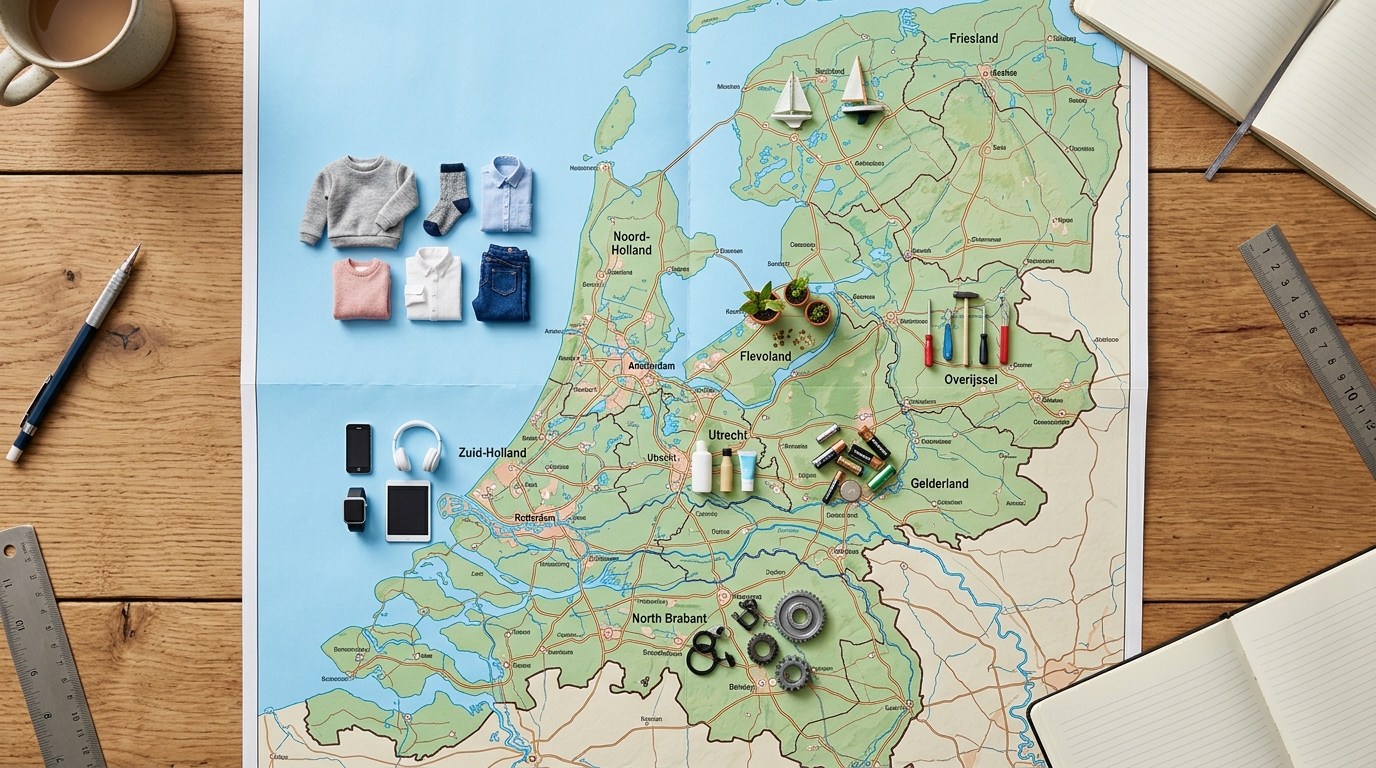
In the Netherlands, four primary EPR regimes govern retail and e-commerce goods. Each regime operates under its own legal decree, establishes distinct reporting deadlines, and designates specific producer responsibility organisations (PROs) to manage collection and recovery operations. While international expansion into destinations such as Germany triggers separate national registrations (such as LUCID or stiftung ear), selling within the Dutch home market requires a precise understanding of the four domestic systems:
- Packaging (Verpact): Covers all primary sales packaging, shipment boxes, filling materials, and labels under the Besluit beheer verpakkingen 2014, with the collective financial contribution due only above 50,000 kg per calendar year[8].
- Electrical and Electronic Equipment / WEEE (Stichting OPEN): Covers electrical and electronic equipment such as phones and household appliances, which the EU WEEE Directive 2012/19/EU requires to be separately collected and properly treated[3], implemented in the Netherlands through the Regeling afgedankte elektrische en elektronische apparatuur and registered via the Nationaal (W)EEE Register.
- Batteries (Stichting OPEN): Covers portable batteries and accumulators supplied loose or embedded within devices under the EU Battery Regulation (EU) 2023/1542 and Dutch implementation rules; vehicle and EV batteries register with ARN instead.
- Textiles (Stichting UPV Textiel): Covers consumer apparel, workwear, and household linens under the Besluit UPV textiel in force since 1 July 2023, with a 2026 collective management fee of EUR 0.24 per kilogram placed on the market[4].
Determining your compliance position begins with a clear product-by-product mapping across these four Dutch EPR schemes. Overlooking a scheme does not suspend statutory duties: the Human Environment and Transport Inspectorate (ILT) oversees compliance with EPR regulations in the Netherlands, and producers are the companies that are first to sell in-scope products on the Dutch market[5].
How scheme boundaries are drawn: function and materials
Regulators assign products to EPR schemes using two distinct criteria: physical material composition and primary functional mechanism. Understanding how Dutch and EU frameworks apply these criteria prevents misclassification and clarifies why single commercial catalogue items frequently activate parallel environmental obligations.
Material-based scope versus functional scope
Material-based regimes focus strictly on the physical substance making up the item. Under packaging EPR and the Besluit beheer verpakkingen 2014, packaging is defined broadly: composite packaging, drink cartons, takeaway packaging, and elements such as labels, caps, and dosage caps all count, and anyone bringing packaging onto the Dutch market must be able to show its weight and the materials it is made of[2]. The purpose of the material defines the scope: corrugated cardboard shipping boxes, plastic mailer bags, tape, bubble wrap, and product containers are evaluated by material weight regardless of what item sits inside.
In contrast, functional regimes evaluate how an item operates. The Waste Electrical and Electronic Equipment (WEEE) regime covers electrical and electronic equipment, from phones and household appliances to medical devices, and requires that this equipment is separately collected, treated, and recycled at end of life[3]. If a product requires electrical circuitry, a motor, or microchips to function, it falls under the WEEE scope managed by Stichting OPEN. Electrochemical energy storage units fall under the battery regime instead, which reaches batteries and accumulators whether they are sold loose, built into an appliance, or added to another product.
- Core function test: Does the item require electricity or generate power to perform its intended primary function? If yes, WEEE or battery regimes apply.
- Material containment test: Is the component intended to enclose, protect, or present the product during transit or sale? If yes, packaging rules apply.
- Textile application test: Is the product wearable consumer clothing, professional workwear, or household bed and table linen? If yes, UPV Textiel applies.
- Component separability test: Can the electronic or battery component be detached without destroying the product, or does the entire unit represent a single integrated e-waste item?
Because material rules and functional rules apply simultaneously, boundaries between regimes do not exclude one another. Instead, they layer over the finished commercial product.
The category-to-scheme reference table
To help Dutch webshops and importers quickly identify which regimes govern their catalogue, the reference matrix below maps common commercial product categories to their primary Dutch EPR schemes, the governing legal decrees, and the responsible Dutch producer organisations.
| Product category | Primary EPR stream | Governing decree / regulation | Responsible organisation / register |
|---|---|---|---|
| Apparel & household linens | Textiles + packaging | Besluit UPV textiel (2023) / Besluit beheer verpakkingen 2014 | Stichting UPV Textiel / Verpact |
| Consumer electronics & appliances | WEEE + packaging (+ batteries if included) | Regeling afgedankte elektrische en elektronische apparatuur | Stichting OPEN (Nationaal WEEE Register) / Verpact |
| Standalone batteries & power banks | Batteries + packaging | EU Battery Regulation (EU) 2023/1542 | Stichting OPEN (Batterijen) / Verpact |
| Toys (non-powered) | Packaging | Besluit beheer verpakkingen 2014 | Verpact |
| Powered / electronic toys | WEEE + batteries + packaging | Regeling AEEA / EU 2023/1542 / Besluit beheer verpakkingen | Stichting OPEN / Verpact |
| Cosmetics & personal care | Packaging (WEEE/batteries for powered tools) | Besluit beheer verpakkingen 2014 | Verpact |
| Furniture & home living (non-electric) | Packaging | Besluit beheer verpakkingen 2014 | Verpact |
| DIY tools & hardware (corded/battery) | WEEE + batteries + packaging | Regeling AEEA / EU 2023/1542 / Besluit beheer verpakkingen | Stichting OPEN / Verpact |
For textile sellers, Stichting UPV Textiel assesses a mandatory management contribution, set at EUR 0.24 per kg in 2026, on consumer apparel, workwear, and household bed and table linen placed on the Dutch market[4]. The Dutch textile rules apply only to producers of newly manufactured clothing (including work clothing), bedding such as duvet covers and sheets, table linen, and other household linen such as towels and tea towels[6], so footwear, leather accessories, and curtains currently sit outside that statutory scope, while their cardboard shoe boxes, plastic bags, and transit packaging remain fully subject to Verpact reporting.
For cosmetics, toys, and furniture, the main product body is often non-regulated in terms of specific material EPR, but the outer bottles, jars, shipping boxes, and protective foam fall directly under Verpact. If a toy or cosmetic accessory includes lights, sounds, heating elements, or rechargeable cells, the classification expands immediately into electronics and battery obligations.
Products that trigger multiple schemes at once
Multi-material and electro-mechanical consumer goods routinely trigger two, three, or four compliance tracks simultaneously. Treating a bundled item as a single commercial unit for sales purposes does not alter the fact that environmental regulators assess each material stream and functional component under separate laws.
Deconstructing composite products into component streams
A standard rechargeable electric toothbrush illustrates how parallel duties layer on a single stock keeping unit (SKU). When imported or placed on the Dutch market, this item triggers three distinct compliance tracks:
- The electric handle, motor, and inductive charger trigger WEEE registration and volume reporting with Stichting OPEN via the Nationaal (W)EEE Register.
- The built-in lithium-ion battery triggers Dutch battery EPR reporting and waste contribution payments with Stichting OPEN under the EU Battery Regulation (EU) 2023/1542.
- The printed retail box, internal plastic thermoformed tray, brush head blister pack, and corrugated outer shipping carton are all packaging of a packed product, and manufacturers and importers are responsible for the waste from the packaging and packed products they bring onto the Dutch market, so these components trigger packaging obligations with Verpact under the Besluit beheer verpakkingen 2014[2].
Similar multi-scheme layers apply across common e-commerce items. A smart watch with a textile strap combines WEEE (the smart module), battery EPR (the internal cell), and packaging EPR (the presentation box); the strap itself is an accessory outside the current UPV Textiel scope. An illuminated winter jacket with integrated LED wiring and a USB power pack combines textiles, WEEE, batteries, and packaging in a single item.
Managing these combinations requires registering in parallel with each relevant producer organisation. Dutch companies must maintain weight and unit records broken down by stream: reporting the total gross parcel weight to a single register fails statutory verification during an ILT audit.
What this means for your webshop and the regulatory outlook
To ensure uninterrupted sales and maintain audit-ready records, Dutch e-commerce operators and importers must translate this category mapping into a structured SKU compliance register. Verifying your product catalogue against statutory definitions avoids hidden compliance gaps across all active sales channels.
- Audit your full product catalogue: Tag each SKU by primary material, power source, and packaging components.
- Identify your statutory role per stream: Confirm whether you manufacture, import from outside the Netherlands, or buy from registered domestic distributors.
- Register with the appropriate PROs: Establish accounts with Verpact for packaging, Stichting OPEN for electricals and batteries, and Stichting UPV Textiel for apparel.
- Set up stream-specific weight tracking: Record net material weights in kilograms for packaging, net device weights for WEEE, chemistry types for batteries, and textile mass for clothing.
- Submit periodic declarations on time: Align internal reporting schedules with each scheme's annual deadline. Textile producers, for example, must submit a compliance report each year before 1 August, stating the amount of textiles they placed on the Dutch market in the previous calendar year[6].
Regulatory outlook: navigating continuous legal development
EPR frameworks across the European Union and the Netherlands remain in active transition. The European Packaging and Packaging Waste Regulation (PPWR), Regulation (EU) 2025/40, entered into force on 11 February 2025 and has applied generally since 12 August 2026[7], and Dutch guidance lists the stricter packaging requirements that took effect on that date[2]. Concurrently, the European Union is developing harmonised textile EPR rules under the revised Waste Framework Directive, while battery requirements continue to phase in under Regulation (EU) 2023/1542.
Because many implementation details, national reporting formats, and future tariff structures are still evolving in official publications, companies cannot rely on static assumptions. Gaining clarity about your obligations as they stand today is the only reliable foundation for managing future regulatory shifts.
Which obligations apply depends on your exact role in the chain for each scheme: who manufactures, imports, sources from Dutch suppliers, or sells under an own label is a producer for one regime and not for another. These distinctions cannot reliably be resolved through a general checklist alone. Our Digital needs analysis evaluates your specific setup and identifies which requirements actually apply to your business, helping you establish structured compliance today and stay covered as regulations develop.
Frequently asked questions
- Which EPR scheme applies to what I sell?
- The applicable Extended Producer Responsibility (UPV) scheme depends on your product's function and material. Verpact covers all packaging, Stichting OPEN manages electrical equipment and batteries, and Stichting UPV Textiel handles clothing. You must map each category individually.
- Who counts as the producer in my setup?
- In the Netherlands, the producer is the entity that first places the product on the market. This includes Dutch manufacturers, importers, and foreign businesses selling directly to Dutch end-users. If you source from a local supplier who already registered, they carry the responsibility for the product; packaging you add yourself for shipping still counts as yours.
- Where do I start if none of this has been arranged yet?
- Begin by identifying all the products you sell and checking them against the scope of the Dutch EPR schemes. You typically have 6 weeks to file a registration once EPR applicability is triggered. Start a comprehensive needs assessment to identify missing registrations before enforcement hits.
- Do accessories and spare parts fall under EPR schemes?
- Yes, but they are often classified separately from the main product. A spare battery for an electronic device must be reported under the battery scheme, while its packaging falls under Verpact. Always evaluate spare parts and accessories as distinct items when assessing your compliance.
- What should I do if no specific scheme seems to fit my product?
- If your product does not clearly fall under WEEE, batteries, textiles, or another specific regime, it may currently sit outside dedicated Dutch EPR regulations. However, you are still responsible for the product's packaging under Verpact, which applies universally to all physical goods.