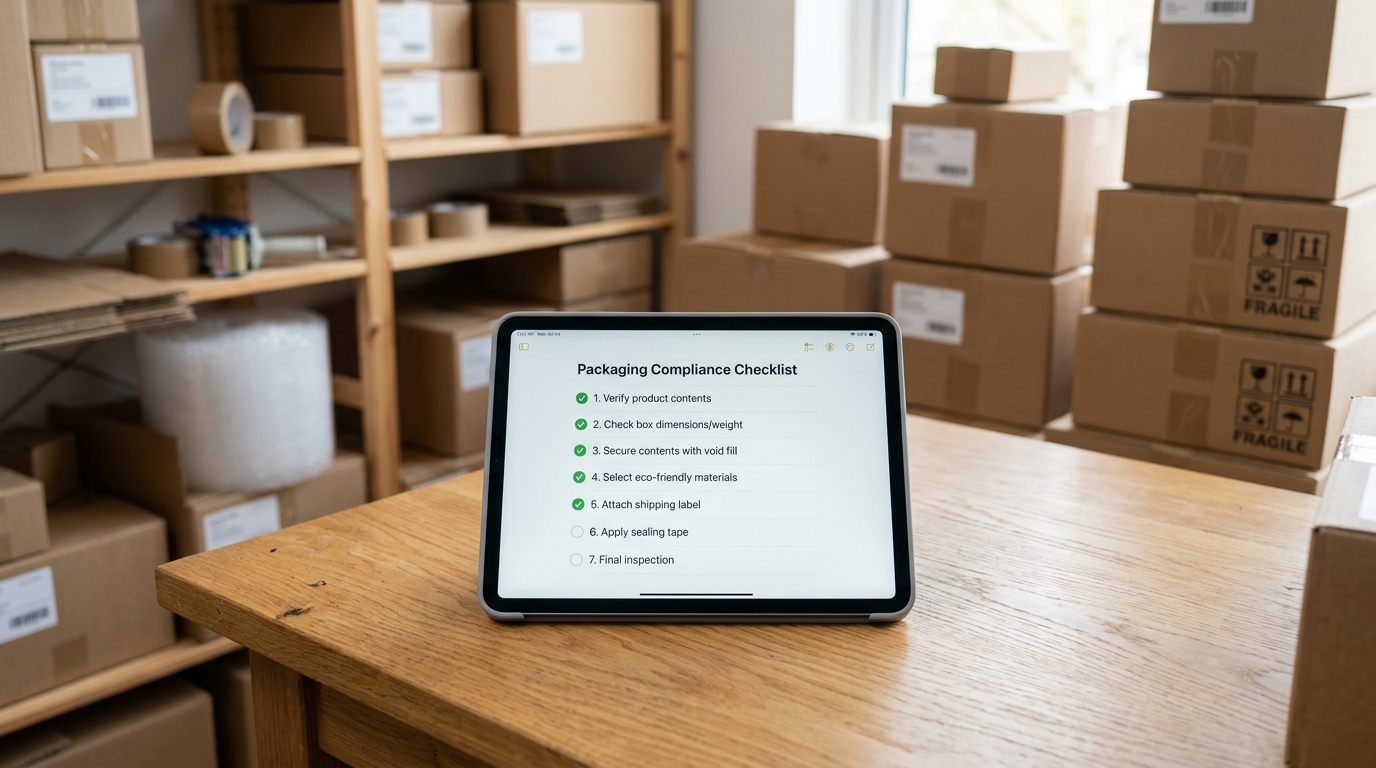
The checklist: what a new webshop must arrange for packaging
As a new webshop selling physical goods in the Netherlands, you must complete four basic packaging compliance steps when bringing packaged products onto the Dutch market. You need to determine whether you qualify as a producer or importer under the 2014 Packaging Management Decree (Besluit beheer verpakkingen 2014), establish a system to record packaging materials and weights from day one, work out where your annual total sits against the 50,000 kg threshold, and register with Verpact and declare once you exceed it. While electrical items and batteries fall under separate Extended Producer Responsibility frameworks, packaging rules apply to every webshop shipping physical orders in the Netherlands.
Packaging compliance for online sellers in the Netherlands centers on producer responsibility. As a manufacturer or importer of packaging or packed products, you are responsible for managing the packaging until the waste phase, which business.gov.nl calls extended producer responsibility under the 2014 Packaging Management Decree[1]. Verpact adds that if you add packaging, for example during repackaging or production, and it is intended for a Dutch consumer, you must include those kilograms in your declaration[2]. In practice that covers the shipping packaging a webshop adds: boxes, mailers, tape, and void fill.
- Verify your producer status: confirm whether you manufacture, import, or add shipping packaging to goods sold on the Dutch market.
- Establish weight tracking: set up an internal recording workflow to capture the material type and weight in kilograms for all primary and shipping packaging. This is the part that applies from your first parcel.
- Diarise the threshold check: monitor your annual total weight, counted across all materials together, so you know the year you exceed 50,000 kg.
- Verpact registration: register your company profile with Verpact, the designated Dutch producer organisation for packaging, and file the annual declaration once you exceed the threshold. Deposit and single-use plastics packaging is declared from the first kilogram whatever your total.
What if your commercial setup is slightly different or involves cross-border sales channels? If you also ship to German customers, Germany enforces its own separate registration under the VerpackDG framework, which replaced the Verpackungsgesetz, and since 12 August 2026 Article 45(3) of the PPWR additionally requires a written mandate appointing an authorised representative for extended producer responsibility in every member state where you make packaging available for the first time and are not established[7]. The Commission proposed suspending that duty for EU-established producers on 10 December 2025 and the Council discontinued negotiations on 24 June 2026, so there is no relief and no small-business carve-out to wait for. To clarify how these rules apply to your specific sales channels, product types, and destination markets, you can complete our Digital needs analysis.
When your obligations start
Your packaging duties start with the first packaged order you place on the Dutch market, not at a revenue milestone or a parcel count. Many webshop founders assume the rules only bite after thousands of shipments per month. In fact, business.gov.nl states plainly that if you bring packaging onto the Dutch market you need to be able to show the weight of the packaging and the materials from which it is made[1]. That record-keeping duty is stated without any volume condition, unlike the contribution and reporting duty further down the same page. The 2014 Packaging Management Decree sets the extended producer responsibility framework that this duty sits in.
Dutch legislation distinguishes between administrative tracking duties and financial contribution obligations. Anyone bringing packaging onto the Dutch market needs to be able to show the weight of the packaging and the materials from which it is made[1], and Verpact's guidance on determining weights works the same way: you weigh the empty packaging yourself, divided up according to the category of material[2]. Neither requirement is tied to a revenue level or a starter allowance.
| Business Stage | Sales / Volume Condition | Administrative Tracking Duty | Financial Contribution Duty |
|---|---|---|---|
| New Webshop Launch | First packaged order placed on NL market | Must be able to show packaging weight and materials | No declaration required below 50,000 kg per calendar year |
| Growing Webshop | Under 50,000 kg total packaging per year | Weigh empty packaging per material category and keep the records | No contribution below 50,000 kg, reassessed annually |
| Established Webshop | More than 50,000 kg of total packaging per year, all materials counted together | Report the weight and quantity of packaging annually, after registering with Verpact | Pay the packaging waste management fee to Verpact, with the first 50,000 kg deducted pro rata per material[6] |
| Any stage, deposit or single-use plastics packaging | No threshold | Declare from the first kilogram | Contribution due from the first kilogram; excluded from the threshold correction[6] |
Starting your tracking workflow on day one prevents historical backlog. Webshops that establish simple material recording from their first shipment maintain full audit clarity, making future regulatory reporting straightforward as order volumes grow.
Edge cases for starters
New webshops often face specific operational setups that require clear classification under Dutch packaging law. Whether you launch mid-calendar year, outsource warehousing to a fulfilment partner, or sell via online marketplaces, the deciding question is which role your business plays in the packaging chain. Business.gov.nl puts it directly: you must determine what role your business plays in the packaging chain, you may have more than one role, and the obligations that apply depend on that role[1].
- Mid-year store launches: If you launch your webshop mid-year, your packaging volume is calculated for the active calendar months. Baseline material tracking starts on your launch date, and total weight is evaluated against the annual threshold for that calendar year.
- The 50,000 kg financial threshold: Dutch packaging duties sit in the 2014 Packaging Management Decree (Besluit beheer verpakkingen)[1]. Under the rules as they apply today, businesses that bring more than 50,000 kilograms of packaging material onto the Dutch market in a calendar year must pay the packaging waste management fee to Verpact and report the weight and quantity of that packaging every year[3]. Verpact confirms that below 50,000 kilos you do not have to file a declaration, but that you must assess on an annual basis whether you still release less than 50,000 kilos[2]. Two qualifications matter for a starter. The 50,000 kg is a total across all packaging materials together, not a limit per material, and deposit packaging and packaging under the single-use plastics rules fall outside it entirely: those are declared from the first kilogram[6]. And crossing the threshold does not make the whole tonnage billable: the first 50,000 kg is deducted from the invoice basis pro rata to each material's share of your weight, so the step up is gradual rather than a cliff[6].
- Fulfilment partners and 3PLs: Verpact is explicit that a logistics provider does not file its own declaration: all operations carried out by a logistics provider on your behalf are taken into account in your declaration[2]. That makes it important to know precisely which packaging your provider adds.
- Marketplace sales: Selling via third-party platforms does not transfer your packaging responsibility if you remain the seller of record shipping goods to Dutch end-consumers.
A clear no-case occurs when you buy pre-packaged goods from a Dutch wholesaler or manufacturer who has already placed that packaging on the Dutch market. Verpact explains that you file a declaration for packaging when it is released on the Dutch market for the first time, so a box that has already entered into free circulation in the Netherlands is only declared once; with second-hand boxes, if they have already entered free circulation here you do not file a declaration[2]. The transport packaging you add or arrange to be added does count towards your own declaration[2].
What to do next: set up records from day one
Setting up a minimal tracking system from your first order turns future Verpact declarations into a routine administrative task. Verpact states that the easiest way of setting up your packing administration depends on your organisation and points businesses to its packaging administration guide to get started[2]. For a new webshop, a structured spreadsheet capturing material category and weight per order type is usually enough to begin with.
- Weigh your standard packaging units: Verpact calls weighing the empty packaging yourself, divided up according to the category of material, the simplest and most reliable method, and says a statement from your supplier is generally not sufficient because suppliers use different definitions[2]. Its packaging administration guide adds that where you rely on supplier information you should check the material types and weights yourself[4]. Do that once per box, mailer, envelope, tape roll and void-fill type and record the result.
- Group by standard shipping sizes: Map your product catalogue to standard parcel types so that packaging weight per order can be calculated automatically from your e-commerce order system.
- Log material categories separately: Keep separate columns per material category, for example paper and cardboard, plastics, glass, metals and wood, since packaging administration consists of the categories of material and the weight in kilos per category of material[2].
- Review total volumes quarterly: Calculate total packaging weight every quarter by multiplying shipped order counts by parcel packaging weights, ensuring your annual total stays accurately documented.
Maintaining organized records protects your business during checks. Verpact runs an acceptability check as soon as you file a declaration or notification, and you may also be selected for verification: Verpact visits you, often together with an independent accountant, and checks the declaration for correctness and completeness, with evidence of your declaration forming part of that inspection[2]. Keeping dated material logs backed by supplier annual statements and your own sample weights is what makes that evidence easy to produce.
Outlook: how the rules develop from here
Packaging regulations across Europe are transitioning toward harmonized rules under the European Packaging and Packaging Waste Regulation (PPWR), formally designated as Regulation (EU) 2025/40, which entered into force on 11 February 2025 and applies from 12 August 2026[5]. Per Verpact's own PPWR timeline, the national producer register is expected from 12 August 2027, with 2028 as the first reporting year, to be declared before 1 June 2029[8]. These implementation milestones reflect current scheme operator expectations and remain subject to final national legislative instruments.
Verpact expects the declaration threshold to disappear once that register is in place, with a simplified declaration for companies placing less than 10,000 kilograms on the Dutch market[8]. That is an expectation, not a rule: no Dutch instrument setting it out has been published in the Staatsblad or Staatscourant, and the contribution levels and calculation basis for smaller volumes have not been determined. A new webshop should therefore build the weight records that would make such a declaration possible, and plan its actual duties against the 50,000 kg threshold that applies today.
Which specific packaging obligations apply to your webshop depends on your exact role in the packaging supply chain. A webshop using standard packaging sourced from a Dutch supplier faces different duties from a business importing packed goods or having packaging manufactured under its own specifications. These distinctions cannot reliably be resolved through a general checklist alone. To understand your compliance position today and be on the safe side, start the EPR needs assessment now. After that, our experts support you in implementing the requirements and keep you covered as the rules evolve.
Frequently asked questions
- What packaging registration must a new webshop complete?
- A new webshop placing packaged goods on the Dutch market must assess its producer status and set up a system to record packaging weights per material from the first parcel. Registering with Verpact and filing the annual declaration follow once you exceed 50,000 kg of packaging in a calendar year, counted across all materials, or immediately for deposit and single-use plastics packaging.
- Does the Verpact packaging registration cost money?
- Registering with Verpact itself is free, and below the threshold you do not need to register or declare at all. You pay a packaging waste management contribution once you bring more than 50,000 kg of packaging material onto the Dutch market in a calendar year, and even then the first 50,000 kg is deducted from the invoice basis pro rata per material.
- What are the compliance costs for a small starter webshop?
- Small starters typically do not pay the waste management contribution as long as they stay under the 50,000 kg threshold. Your primary investment is the administrative time needed to track your standard packaging weights and file the annual declaration.
- What happens if I registered my webshop packaging late?
- Registering late can lead to enforcement by the authorities and retroactive contribution charges for past years. Correcting your status proactively is always better than waiting for an audit. A compliance check can help map out your next steps safely.
- Do I need a separate registration for shipping to Germany?
- Yes. Your Dutch Verpact registration does not cover exports to Germany. If you ship goods across the border to German consumers, you must complete a separate registration in the LUCID Packaging Register and license your volumes with a dual system. Since 12 August 2026 you also need an authorised representative for extended producer responsibility in Germany under Article 45(3) of the PPWR, and one in every other member state you ship to and are not established in.