The primary answer: Stichting OPEN as the central register
Dutch businesses must join Stichting OPEN before placing electrical and electronic equipment, or portable batteries, on the Netherlands market. Vehicle, industrial and light-transport batteries run through their own organisations rather than Stichting OPEN. Under Dutch rules implementing the Regeling AEEA, you carry extended producer responsibility (EPR) if your business is the first to market equipment under its own name or brand in the Netherlands, is the first to import and market equipment, or sells from abroad directly to Dutch end users, and that responsibility runs up to and including the waste phase[1]. The Nationaal (W)EEE Register (NWR) is the register appointed by the government, but producers do not enrol there directly: because the waste management contribution agreement for WEEE has been declared generally binding, all producers of EEE are obliged to join Stichting OPEN, and registration with the NWR is part of that affiliation[2]. The declaration in force was taken on 22 December 2025, published in the Staatscourant on 2 January 2026, and runs from 1 January 2026 to 31 December 2030[4].
For cross-border sellers, regulatory boundaries are strictly national: registering with Stichting OPEN covers only your Dutch market activities, whereas selling into Germany requires a separate registration with stiftung ear under the German ElektroG and BattDG. That difference matters on marketplaces: German law makes the platform itself check the register, because section 6(2) ElektroG obliges operators of electronic marketplaces to verify that manufacturers offering electrical equipment are registered with stiftung ear, and forbids them to allow unregistered devices to be offered[5]. Dutch law places no equivalent verification duty on marketplaces for electrical equipment, so a missing Stichting OPEN affiliation is enforced by the ILT rather than by the platform.
- Central administration: Stichting OPEN acts as the sole collective producer organisation (PRO) covering all Dutch WEEE streams and portable batteries.
- Single point of entry: You do not register directly with the Ministry; submitting your onboarding through the MyOPEN portal satisfies your legal duty toward the National (W)EEE Register.
- Zero de minimis: There is no minimum sales threshold or turnover exemption for electrical equipment in the Netherlands; your obligations begin with the very first unit placed on the market.
Scope test: Recognizing producer status and AEEA categories
Determining your compliance duties requires checking whether your business acts as a producer and whether your product range counts as electrical and electronic equipment. You have producer responsibility if you are the first to market equipment under your own name or brand in the Netherlands, the first to trade in equipment under your own brand here, the first to import and market it, or if you sell from abroad directly to end users in the Netherlands[1]. Since 15 August 2018 all products with an electrical function are within the scope of the Regeling AEEA unless the regulation lists a specific exception[2].
Conversely, an explicit no-case applies when a Dutch retailer sources products exclusively from a Dutch domestic distributor or brand owner that has already fulfilled the registration and paid the waste management contribution to Stichting OPEN. In that scenario, your supplier is the producer, provided you retain commercial invoices proving that domestic fees were paid upstream.
| Electrical Category | Regulatory Scope Criteria | Example Products |
|---|---|---|
| Category 1: Temperature exchange equipment | Appliances with integrated cooling, heating, or refrigerant circuits | Refrigerators, air conditioners, heat pumps |
| Category 2: Screens and monitors | Displays with a surface area greater than 100 cm² | Computer monitors, televisions, digital picture frames |
| Category 3: Lamps | Gas discharge lamps and LED retrofit bulbs | LED spotlights, fluorescent tubes, compact fluorescent lamps |
| Category 4: Large equipment | Appliances where any external dimension exceeds 50 cm | Washing machines, dishwashers, large commercial printers |
| Category 5: Small equipment | Appliances where no external dimension exceeds 50 cm | Toasters, electric toothbrushes, vacuum cleaners, smart home hubs |
| Category 6: Small IT and telecommunications | IT equipment with no external dimension exceeding 50 cm | Mobile phones, routers, GPS units, wireless keyboards |
If your commercial setup sits on the edge of these definitions, particularly when sourcing mixed components or bundling accessories, you can start the Digital needs analysis to clarify your exact status across all active Dutch EPR schemes.
The registration process: MyOPEN account and marketplace proof
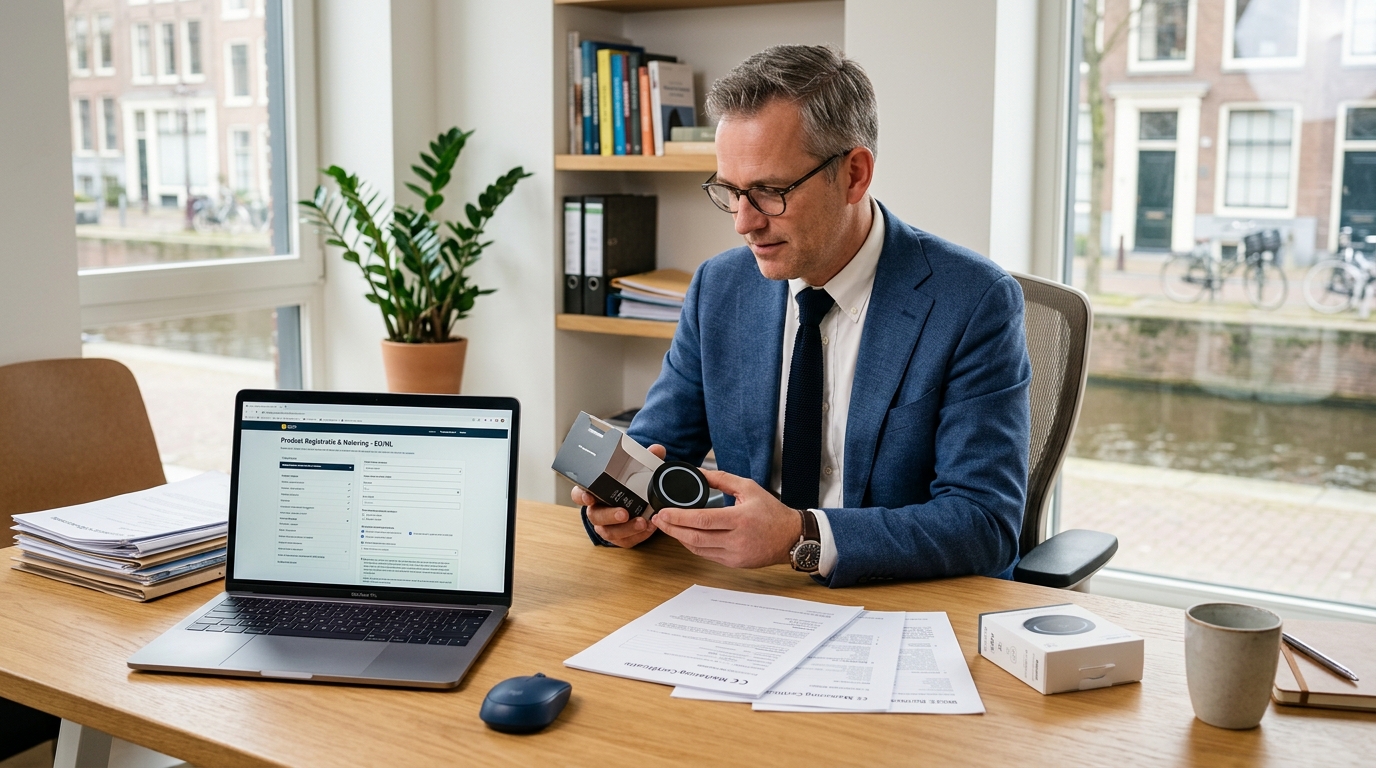
Registration with Stichting OPEN takes place entirely through their digital portal, MyOPEN. Completing this process establishes your legal producer file and transmits your data to the National (W)EEE Register, creating the compliance proof required by e-commerce platforms.
- Company identification: Enter your legal entity details, Netherlands Chamber of Commerce (KVK) number, Dutch VAT identification, and primary contact information.
- Category assignment: Select the applicable equipment groups from the 6 main statutory categories and 70 detailed subcategories defining your product catalog.
- Battery declaration: If any of your electronic devices include integrated or standalone batteries, activate the integrated battery module within the same onboarding workflow.
- Verification and confirmation: Stichting OPEN validates your master data and issues your confirmation of participation, linking your entity to the central NWR database.
Keep the confirmation of participation on file: marketplaces increasingly ask sellers for producer registration numbers per country, and since 12 August 2026 Article 45(4) PPWR requires platforms to collect and check them for packaging. There is no equivalent statutory duty on Dutch marketplaces for electrical equipment today, so treat a platform request as an administrative step rather than as the thing that makes you compliant: the registration obligation itself runs to Stichting OPEN and is supervised by the ILT.
After registration: Deadlines, volume reports, and batteries
Registration is an ongoing administrative framework rather than a one-time formality. Once your account is active in the MyOPEN 2.0 portal, you must report your actual "Put on Market" (POM) volumes, detailing the exact quantities and net weights of equipment distributed in the Netherlands.
Reporting cadence depends on the size of your company: larger participants submit their "Put on Market" reports quarterly, while other participants report annually, and Stichting OPEN notifies you through MyOPEN when a report is due[3]. Since 1 January 2025, all participants file through the MyOPEN 2.0 platform. Stichting OPEN confirms your applicable frequency and deadlines when it sets up your participant file, so check the cadence stated in your own account rather than assuming an annual declaration.
| Reporting Element | Reporting Rule | Weight & Unit Scope |
|---|---|---|
| Electrical appliance weight | Net weight of the device including electronic accessories | Excludes packaging, manuals, and any included or integrated batteries |
| Integrated batteries | Reported separately under the battery declaration by chemistry and piece count | Not included in the reported appliance weight |
| Export refunds | Available if goods were bought from a producer/importer registered with Stichting OPEN and then actually exported | A management statement accompanies each export declaration, and if annual reporting exceeds EUR 50,000 an auditor's assurance report is required at the end of the reporting year |
A common operational mistake is reporting the total gross parcel weight under electrical equipment. If you sell an electric toothbrush, for example, the device weight without its rechargeable cell is entered under Category 5, while the battery cell is declared separately by chemistry type in the battery declaration.
Outlook: Evolving EU rules and securing your compliance
The regulatory architecture governing electronics and energy storage continues to adjust across the European Union. Regulation (EU) 2023/1542 (the EU Batteries Regulation) entered into force on 17 August 2023 and has applied since 18 February 2024; conformity assessment and economic-operator obligations followed on 18 August 2024, waste-battery management and due diligence on 18 August 2025, and the removability and replaceability requirements for portable batteries apply from 18 February 2027[6]. Further revisions to the European WEEE Directive remain in legislative development.
Because national obligations depend on your exact role in the supply chain (whether you manufacture, import, source from domestic wholesalers, or distribute private-label goods), these distinctions cannot reliably be resolved through a general checklist alone. To understand your compliance position today and be on the safe side, start the Digital needs analysis now. Afterwards, ClearoSystems experts support you in implementing the necessary registrations and keep your business covered as the regulatory framework evolves.
Frequently asked questions
- Does this apply to my business?
- Yes, if you are the first to place electrical appliances or batteries on the Dutch market, whether by manufacturing, importing, or selling under an own brand.
- What exactly do I have to register or report?
- You must register your company via MyOPEN and report the net weight of devices and batteries placed on the market, categorized into the 70 official AEEA subcategories.
- What happens if I am late?
- Failing to register before placing products on the market breaches the Regeling AEEA and exposes you to enforcement by the Human Environment and Transport Inspectorate (ILT). Dutch marketplaces are not obliged to check electrical-equipment registrations, so do not treat an undisturbed listing as evidence that you are compliant; in Germany the platform must check the stiftung ear register and may not let unregistered devices be offered.
- Can I register directly with the Nationaal (W)EEE Register?
- No. Because the waste management contribution agreement has been declared generally binding, currently for 1 January 2026 to 31 December 2030, so producers must join Stichting OPEN, which handles the NWR registration on their behalf.
- How do I handle devices with built-in batteries?
- The appliance and its integrated battery must be reported separately. You report the net weight of the device excluding the battery, and report the battery separately.