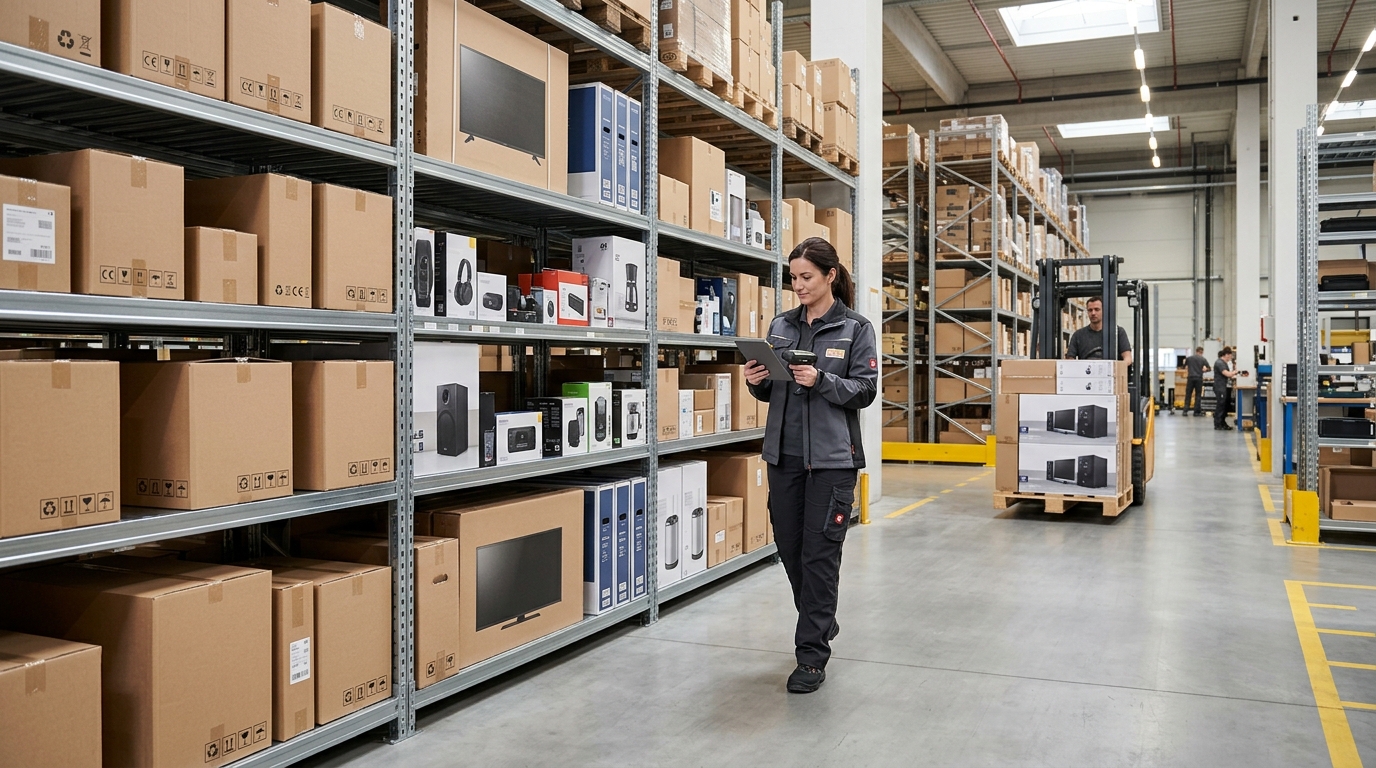
Complete applications usually take two to four weeks
Applications are reviewed in the order they are received, and they cannot be moved up the queue.[1] How complete and correct the application is has a major influence on the processing time. With a high volume of applications or in complex cases, it can still take longer.
The total duration also includes the steps before the actual application. They are in your hands and help determine when the usual processing time of two to four weeks even begins:
- Create a user account in the ear portal, unless you already have a business account (“Mein Unternehmenskonto”), and confirm the email address within seven days.
- Add a person authorised to represent the company and enter the payment details.
- Submit the ElektroG registration application for each brand and type of equipment, including proof of the guarantee or the B2B substantiation.
Only once these steps are complete does stiftung ear review the application. Whether you are a manufacturer, importer, reseller or authorised representative, your role determines what the application must contain. A setup in electrical equipment sales with an own brand, imports from abroad or distance selling cannot be judged against a general checklist. A ClearoSystems consultation clarifies your role and next steps for your specific situation.
What a complete application depends on
The registration application must contain the details listed in Annex 2 ElektroG; if mandatory details are missing, registration may not be granted (Section 37(1) in conjunction with Section 6(1) ElektroG).[2][3][4] The key mandatory details at a glance:
| Detail under Annex 2 ElektroG | What to enter |
|---|---|
| Producer or authorised representative | Name and address of the producer; where a representative is appointed, also the name and address of the representative and of the producer represented |
| Contact person | Name of the person responsible for the registration, with telephone number and email address |
| Brand and type of equipment | The brand or brands on the equipment, and each type of equipment to be placed on the market |
| Type of use | For equipment that can be used in private households, proof of the insolvency-proof guarantee; for B2B-only equipment, the substantiation with a take-back concept |
Two points drive the duration in particular. First, the structure: a separate registration is required for each brand and type of equipment. If you sell under several brands or types of equipment, the scope of the application multiplies. Second, the brand itself: it must allow clear attribution to the producer. The company name is permitted, even without a registered trademark. Terms such as “no brand”, pure model designations or equipment descriptions such as “USB stick” are not permitted.[1]
The line between B2C and B2B is a sticking point: equipment that can be used in private households needs the guarantee; equipment used exclusively for business purposes needs the substantiation and a take-back concept. If the type of use is not sufficiently documented, registration cannot be granted until the required conditions have been demonstrated.
Sell only after the registration notice
Under Section 6(2) ElektroG, producers may not place equipment on the market without proper registration. Distributors may not offer their equipment for sale, marketplace operators may not enable such offers, and fulfilment service providers may not handle storage, packaging or shipping for it.[5] From the producer's perspective, stiftung ear puts it this way: equipment may only be placed on the market once the registration notice has been issued.[1] So plan your sales start for after that notice, not after submitting the application.
What you can prepare while the application is in progress:
- For equipment usable in households (B2C): the insolvency-proof guarantee, for example a first-demand guarantee from a credit institution.[1]
- For B2B-only equipment: substantiation of exclusively commercial use plus a take-back concept that sets out the return options for each type of equipment.[5]
- The statutory fees, which apply regardless of the processing time and should be budgeted separately.
| Fee item (ElektroGBattDGGebV) | Fee |
|---|---|
| Registration per producer, brand and type of equipment | €9.50[6] |
| Quarterly fee per registration number and per calendar quarter begun | €32.80[6] |
| Review of a producer-specific guarantee in principle | €156.90[6] |
| Review of the B2B substantiation and take-back concept per registration | €18.90[6] |
All fees listed are subject to any applicable VAT where a service is subject to VAT (Section 1(1) ElektroGBattDGGebV).[7]
What to note on processing time and fees
The two to four weeks are a practical guideline from stiftung ear (“as a rule”), not a statutory deadline. The registration notice is sent by email; only then may equipment be placed on the market.[1]
The fees are based on the ElektroGBattDGGebV, last amended by an act of 30 September 2025. They may be reset by a further amendment of the ordinance.[6] Whether and when that happens cannot be foreseen at present, so do not carry today's rates over to future applications; check the current status each time.
If you need clarity on your role and next step today, for example with an own brand, imports or an upcoming market entry, you can request a ClearoSystems consultation. The experts support the implementation even as requirements evolve. For a first assessment of which obligations apply to your company in which countries, the EPR needs analysis is a good starting point.
Frequently asked questions
How long does registration with stiftung ear take?
Usually two to four weeks, provided the application is complete and correct. The key distinction: the processing time only starts with the complete registration application, not when the user account is created. As stiftung ear stresses, you largely determine the duration yourself, because preliminary steps such as the account, the authorised representative of the company and the payment details are in your hands.[1]
What does ear registration cost, one-off and per year?
The one-off and ongoing costs are in the fee table above. For annual budgeting: the quarterly fee applies per registration number and per calendar quarter begun, including the quarter of registration itself. If you sell under several brands or types of equipment, you pay registration and review fees per combination, which multiplies the total cost. All rates are based on the current version of the ElektroGBattDGGebV and are subject to any applicable VAT (Section 1(1) ElektroGBattDGGebV).[7]
May I sell while my stiftung ear application is pending?
No. Equipment may only be placed on the market once stiftung ear has issued the registration notice; the bans for distributors, marketplaces and fulfilment service providers apply regardless of how far the application has progressed (Section 6(2) ElektroG).[5] Use the waiting time to prepare the guarantee, the take-back concept and your volume planning.