Orientation and the Stichting OPEN system
Extended Producer Responsibility (EPR) for batteries in the Netherlands requires every company that places batteries on the Dutch market to finance their collection, sorting, and high-quality recycling from the very first unit. These statutory obligations apply to domestic manufacturers, direct importers, private-label brand owners, and cross-border distance sellers delivering to Dutch consumers. As a commercial seller, you must determine whether your product catalogue contains standalone or integrated batteries, register with the designated national collective scheme, and declare your put-on-market volumes on a periodic basis.
The institutional landscape for battery compliance in the Netherlands underwent a fundamental consolidation on 1 January 2024. Stichting OPEN (Stichting Organisatie Producentenverantwoordelijkheid E-waste Nederland) merged with Stichting Stibat Services, the administrative organisation of Stichting Batterijen (historically known as Stibat), and participants in the former Stibat scheme moved across to Stichting OPEN under the new general binding statement from that date[1]. Today, Stichting OPEN centrally directs the EPR collection and recycling infrastructure for both electrical appliances and batteries across the Netherlands. The historical brand Stibat remains purely as legacy context.
The system operates under a general binding statement (algemeen verbindend verklaring, or AVV), which makes registration with Stichting OPEN and payment of a waste management fee compulsory for portable batteries, unless you hold an exemption[2]. The current AVV for spent batteries has been declared binding from 1 January 2024 to 31 December 2028; since 18 August 2025 the underlying agreement covers portable batteries from 0 to 5 kg and industrial batteries from 0 to 1 kg[6]. Under this framework, participating producers register digitally, submit their volume data, and pay an environmental waste management contribution (afvalbeheerbijdrage) that is based on their annual production and import report[3]. These contributions fund the shared national collection and recycling system, which operates towards consumers under the Wecycle brand and now counts 30,000 drop-off points for spent batteries[4].
| System Element | Operational Implementation | Legal and Administrative Basis |
|---|---|---|
| Executing Organisation | Stichting OPEN (absorbing the Stibat battery scheme as of 1 January 2024) | Merger with Stichting Stibat Services under the general binding statement running from 1 January 2024 to 31 December 2028 |
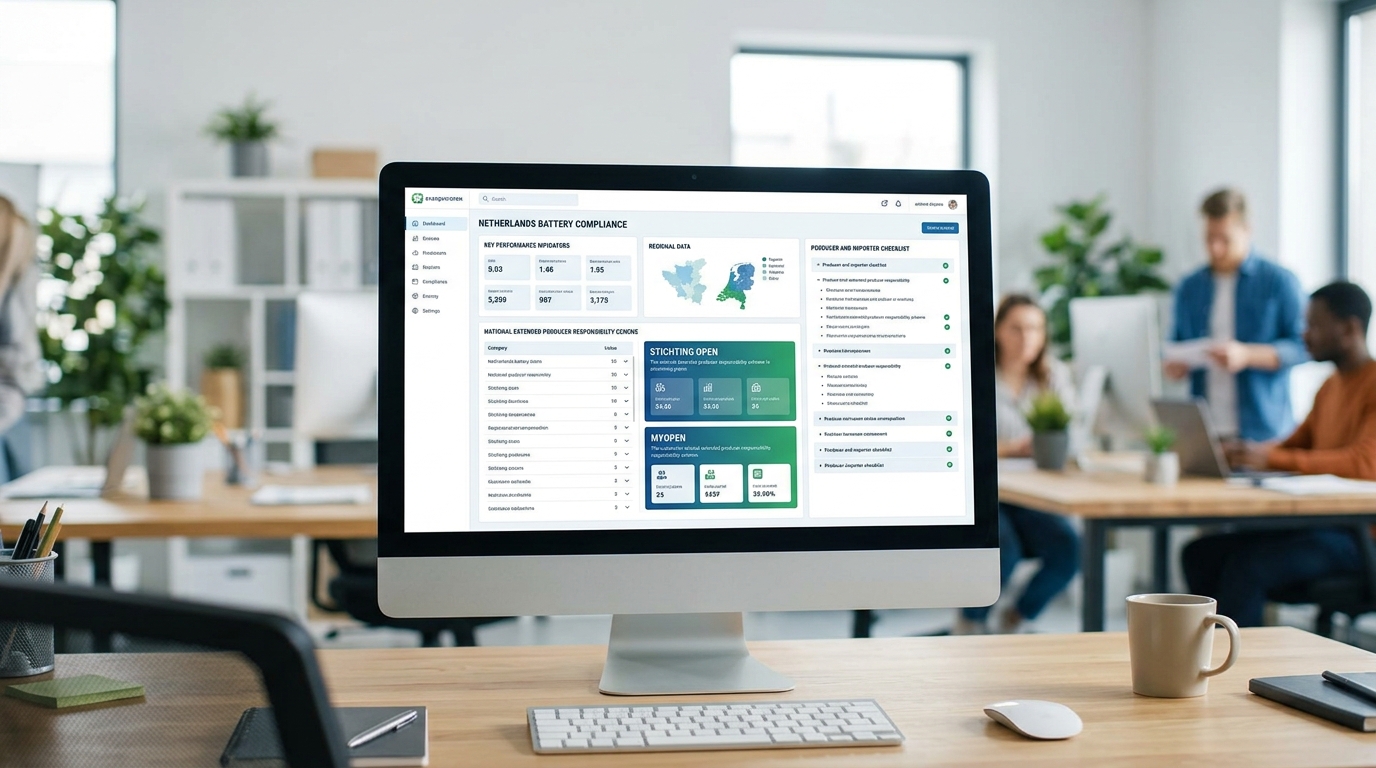
| Registration Portal | MyOPEN online platform for onboarding and continuous volume reporting | Registration with Stichting OPEN and payment of a waste management fee is compulsory for producers and importers of portable batteries, unless exempt |
| Financing Model | Waste management fee (afvalbeheerbijdrage) based on your annual production and import report, differentiated by battery chemistry | Stichting OPEN waste management contribution rules |
| Public Collection Network | 30,000 Wecycle drop-off points for spent batteries | National collection infrastructure for portable cells, with at least one drop-off point per 2,000 inhabitants in every municipality |
For Dutch businesses, completing your Stichting OPEN registration is not an optional industry standard, but a mandatory precondition before distributing battery-powered inventory in the Dutch market.
Who is in scope of the battery obligations
Dutch battery EPR law defines the liable party through the concept of the producer. You are legally classified as a producer if your business is the first to market batteries, accumulators or products containing them in the Netherlands under your own brand or name, or if you import them into the Netherlands[2], and no company-size or turnover threshold exempts you.
In practical terms, the producer definition captures four distinct commercial activities:
- Domestic manufacturers: Companies producing finished batteries or battery-powered devices in the Netherlands and selling them under their own trade name.
- Direct importers: Dutch companies that source battery-containing products from other EU member states or non-EU countries and bring them into the Netherlands for distribution.
- Private-label sellers: Businesses that commission third-party manufacturers to produce battery-powered products branded exclusively under their own company label.
- Cross-border distance sellers: International e-commerce merchants and webshops that ship battery-powered products directly to Dutch consumers without maintaining a local Dutch branch.
Because the producer definition explicitly covers products containing batteries as well as the batteries themselves, the obligation applies equally whether the battery is sold as a loose, standalone component (such as consumer AA cells, replacement packs, or power banks) or permanently integrated inside a finished device (such as smart home sensors, electric toothbrushes, or wireless headphones)[2].
An explicit exemption applies to pure domestic downstream retailers: if you purchase all your battery-containing inventory from an established Dutch wholesaler or domestic supplier who is already registered with Stichting OPEN and has settled the statutory waste management contribution, you do not qualify as the primary producer for those units. However, when importing products from foreign suppliers, the full producer responsibility automatically shifts to your business.
The scope of obligations also depends on the specific battery classification under European and Dutch rules:
- Portable batteries (draagbare batterijen): Sealed units up to 5 kg that are not designed for industrial or automotive applications. Collective registration with Stichting OPEN is compulsory for portable batteries up to 5 kg[2].
- Industrial batteries (industriële batterijen): Units designed specifically for industrial, commercial, or infrastructural use. Industrial batteries up to 1 kg are covered by the same binding agreement as portable batteries since 18 August 2025 and therefore fall inside the collective scheme[6]; heavier industrial batteries sit outside it.
- Light Means of Transport (LMT) batteries: Traction batteries engineered to propel light wheeled vehicles such as electric bicycles, cargo bikes and e-scooters. Bicycle batteries run under their own scheme with its own binding statement, while car starter and EV batteries are registered with Auto Recycling Nederland (ARN) instead[2].
Your specific duties in detail
Once your business falls within the scope of battery EPR, you must satisfy a continuous sequence of administrative, financial, and operational duties. Environmental compliance is structured as an ongoing operational cycle rather than a one-time formality: alongside registration you must arrange collection and recycling, inform end users, and report annually to Rijkswaterstaat before 1 August on the weight of batteries you placed on the market and collected in the previous year[2].
Under the current regulatory framework administered by Stichting OPEN and monitored by the Human Environment and Transport Inspectorate (ILT), your primary duties comprise five core requirements:
- Pre-market registration: You must register with Stichting OPEN and pay a waste management fee before placing batteries or battery-containing products on the Dutch market, unless you hold an exemption[2].
- Periodic volume declarations: You must declare the net quantities and weights of the batteries you place on the market through the MyOPEN portal, and report annually to Rijkswaterstaat on the weight placed on the market and the weight collected and processed.
- Contribution settlement: Producers and importers of batteries must pay the waste management contribution (afvalbeheerbijdrage) to Stichting OPEN, an amount based on the annual production and import report, so that everyone shares the cost of the collection and recycling system[3].
- Take-back infrastructure support: Retailers selling batteries or products containing them must take back discarded batteries free of charge and inform consumers where they can hand them in[2].
- Product labelling and consumer information: All batteries must carry the separate collection symbol (the crossed-out wheeled bin), and batteries containing more than 0.002% cadmium or more than 0.004% lead must additionally carry the chemical symbol Cd or Pb; the old Battery Directive was repealed with effect from 18 August 2025[5]. You must also inform end users about separate collection.
For electronic product sellers, maintaining precise master data is critical: you must record the exact net weight and chemical type for every integrated cell across your entire stock-keeping unit (SKU) database.
What this means for your business
Complying with battery EPR introduces specific administrative routines and cost calculations into your daily business operations. Your contribution is calculated from your annual production and import report and funds the shared collection and recycling system, so that every producer and importer carries a proportionate share of the cost. Because rates are set per battery type, the chemistry you place on the market (for example alkaline cells versus lithium-ion packs) affects what you pay.
A frequent operational challenge for digital commerce is the intersection between battery rules and electrical equipment rules. Selling a battery-powered device triggers two parallel EPR tracks simultaneously: the battery stream and the electrical equipment stream (WEEE / AEEA).
While Stichting OPEN manages both streams centrally in the Netherlands, the reporting logic requires strict separation. When submitting declarations for an electronic product, you must report the electrical appliance weight under your WEEE registration while reporting the battery separately under your battery declaration. To avoid double charging, the net weight of the battery must be deducted from the gross weight of the electrical device.
| EPR Compliance Parameter | Battery Track (Batteries UPV) | WEEE Track (AEEA UPV) |
|---|---|---|
| Governing Framework | Besluit beheer batterijen en accu's / EU Battery Regulation | Regeling afgedankte elektrische en elektronische apparatuur |
| Triggering Element | Any loose or integrated cell, battery pack, or accumulator | Any device dependent on electric currents or electromagnetic fields |
| Declaration Unit | Net battery weight by chemistry (Li-ion, Alkaline, etc.) | Net appliance weight by WEEE category (excluding battery) |
| Marking Requirement | Crossed-out wheeled bin and chemical indicators | Crossed-out wheeled bin and producer identification mark |
In parallel, Regulation (EU) 2023/1542 of the European Parliament and of the Council significantly raises the technical standard across the European Union[7]. The regulation entered into force on 17 August 2023 and became broadly applicable on 18 February 2024, with Chapter VIII governing extended producer responsibility applying from 18 August 2025[6].
The EU regulation introduces mandatory removability and replaceability rules for portable batteries in consumer appliances starting from 18 February 2027, requiring that portable cells can be easily removed and replaced by end users without specialised tools[7]. Furthermore, businesses active across borders must note that compliance in the Netherlands does not extend abroad: selling into Germany, for instance, requires a separate registration with stiftung ear under German national law.
Outlook and next steps
Environmental compliance for batteries remains an evolving domain at both the European and national levels. Under Regulation (EU) 2023/1542, the European Union has established progressive collection targets for waste portable batteries, rising to 63% by the end of 2027 and 73% by the end of 2030[6]. In response, national collection mechanisms, fee structures, and technical documentation requirements will continue to adapt.
Because several secondary implementing acts, national decrees, and administrative procedures remain under active development by regulatory authorities, long-term administrative details two years out cannot be stated with absolute certainty today. Regulatory adjustments will become definitive only as formal texts are enacted and published in official journals. This makes establishing structured, compliant processes under today's active rules the only reliable strategy.
The general rule is clear: every commercial entity placing batteries on the Dutch market must be registered with Stichting OPEN and report its volumes accurately. However, which exact battery and WEEE obligations apply depends on your specific role in the supply chain:
- Direct import: Sourcing finished goods directly from overseas suppliers triggers primary producer liability for both packaging, WEEE, and integrated batteries.
- Private labelling: Contracting third-party assembly lines to manufacture custom electronic goods places full producer registration duties on your brand.
- Domestic distribution: Reselling stock procured exclusively from registered Dutch distributors shifts primary reporting duties upstream, provided compliance documentation is verified.
- Mixed retail: Operating multi-channel webshops with combined domestic and foreign product streams requires segregated volume tracking.
These role-specific distinctions cannot reliably be resolved through a general checklist alone. To understand your compliance position today and be on the safe side, start the Digital needs analysis now. Afterwards, our experts at ClearoSystems support you in implementing the requirements and keep your business covered as the regulatory rules evolve.
Frequently asked questions
- Which scheme applies to what I sell?
- In the Netherlands, Stichting OPEN manages the collective EPR scheme for batteries. If you place portable batteries (up to 5 kg) on the market, you must register via the MyOPEN platform and pay the waste management fee to fund the national collection network.
- Who counts as the producer in my setup?
- You are considered a producer if you are the first to place batteries on the Dutch market. This includes manufacturing them, importing them from abroad, selling under your own private label, or distance selling directly to Dutch consumers. The obligation binds you from the very first battery.
- Where do I start if none of this has been arranged yet?
- You must begin by determining your exact role and scope of products. Next, register with Stichting OPEN before making your first sale. Finally, declare your volumes and ensure your waste management fees are paid. To be on the safe side, start with a Digital needs analysis to map out your specific requirements.
- Does battery EPR apply if I only sell devices with built-in batteries?
- Yes. Extended producer responsibility applies whether batteries are sold loose or integrated into a product. If you sell electronics with built-in batteries, you must comply with both the WEEE obligations for the device and the separate battery EPR requirements.
- How has the transition from Stibat to Stichting OPEN changed my duties?
- On 1 January 2024, Stibat formally merged into Stichting OPEN, which now manages both WEEE and battery EPR in the Netherlands. While the underlying legal responsibility remains the same, your operational tasks, such as registration and periodic weight reporting, are now handled entirely through the MyOPEN portal.