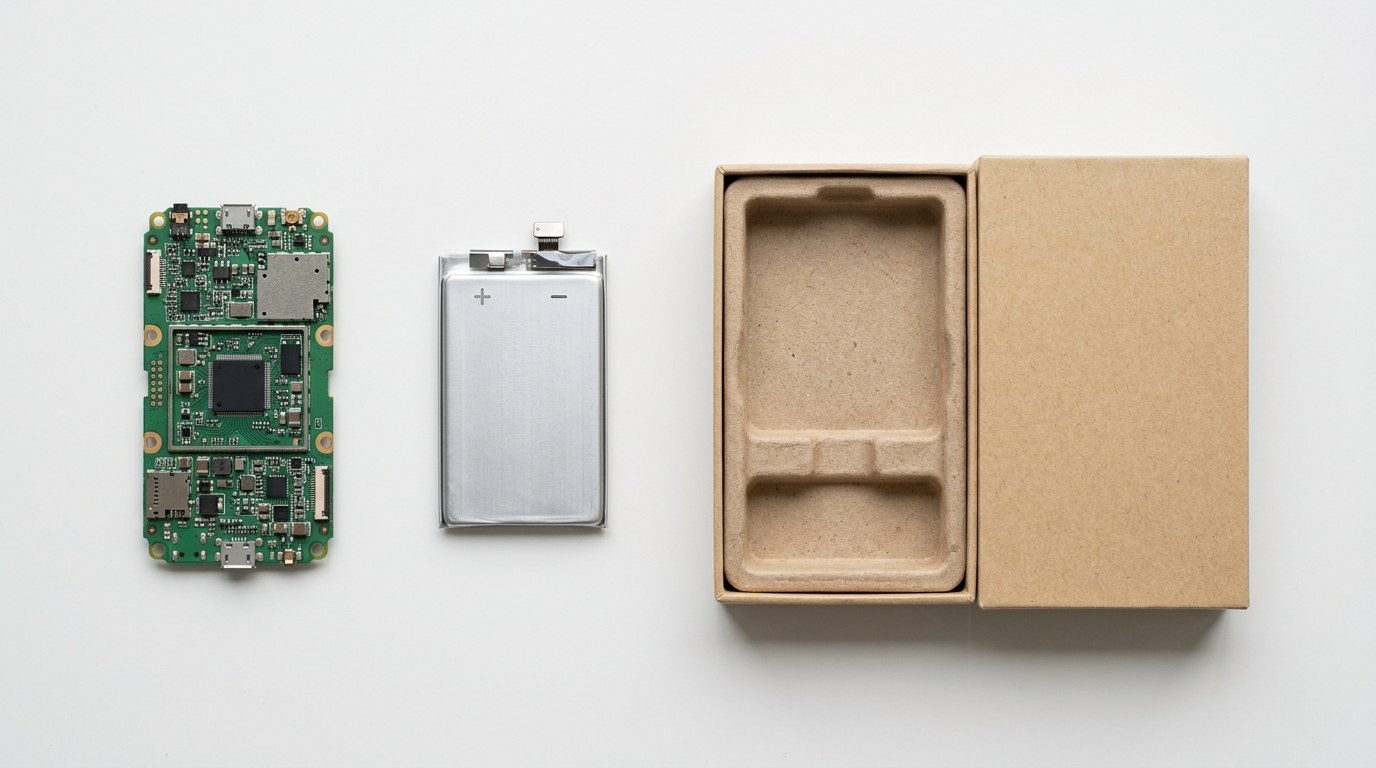
One gadget, three Dutch EPR obligations
Extended Producer Responsibility (EPR) requires companies that place physical goods on the market to finance their end-of-life collection and recycling. For any company selling a battery-powered device, this legal obligation does not apply as a single broad rule, but splits into three distinct compliance tracks for the exact same physical unit. Determining your obligations means establishing whether your business acts as the first commercial placer of the electronic hardware, the battery cell, and the packaging materials.
Breaking down the product into three compliance streams
When a business sells a connected electronic item, environmental law divides the product into separate constituent parts. The electrical circuitry, casing, and cables fall under Waste Electrical and Electronic Equipment (WEEE) regulations. The integrated or enclosed power source falls under battery legislation. The cardboard box, plastic blister, protective wrap, and shipping carton fall under packaging waste rules. Understanding how Dutch EPR schemes divide these responsibilities across producer responsibility organisations is essential for proper administration.
| Product component | EPR regime | Dutch producer organisation | Core legal scope |
|---|---|---|---|
| Electronic device and cables | WEEE (AEEA) | Stichting OPEN | Collection and recycling of electrical waste on behalf of producers and importers |
| Integrated or enclosed battery | Batteries (Batterijen) | Stichting OPEN | Collection and recycling of built-in, loose, and bicycle batteries |
| Box, blister, and shipping box | Packaging (Verpakkingen) | Verpact | Paying for and organising the collection and recycling of packaging materials |
In the Netherlands, these three streams are managed by two primary producer responsibility organisations. Stichting OPEN administers both the electrical equipment regime and the battery regime, following the operational integration of battery organisation Stibat into Stichting OPEN on 1 January 2024[1]. Meanwhile, Verpact manages the packaging waste regime. Even when a single product contains all three elements, each stream requires its own registration, material classification and regular volume reporting; our article on battery EPR in the Netherlands covers the battery scheme in depth.
How Stichting OPEN and Verpact work in practice
Operationalising compliance across multiple EPR schemes requires managing two distinct administrative environments. While both systems aim to fund collection and recycling infrastructure, their registration portals, reporting frequencies, and billing mechanisms operate under separate legal frameworks. For electronics sellers navigating cross-border trade, coordinating these duties avoids dual registrations or missed declarations.
Registration, volume reporting, and threshold differences
For electrical hardware and batteries, companies register with Stichting OPEN and report annually what they place on the Dutch market, submitting their put-on-market figures through the myOPEN portal[3]. Importers and manufacturers declare what they bring onto the Dutch market across defined equipment categories and battery types, including loose batteries and bicycle batteries. Fees take the form of a waste management contribution (afvalbeheerbijdrage) that funds the collection, sorting, and processing of discarded products[3].
Packaging compliance runs through Verpact under the Besluit beheer verpakkingen 2014, the 2014 Packaging Management Decree[2]. Companies must register their packaging activities and maintain auditable records of all packaging put on the Dutch market, including its weight and the materials it is made from. Under Dutch packaging rules, bringing more than 50,000 kg of packaging onto the Dutch market in a calendar year, counted across all materials together, triggers the packaging waste management contribution (afvalbeheersbijdrage) to Verpact and the annual declaration of the quantity placed on the market[7]; above that line the first 50,000 kg are deducted pro rata per material. Businesses staying below that volume remain responsible for their packaging administration, but file no declaration and pay no contribution; deposit and single-use plastic packaging have no threshold at all. Note that Germany has its own registers, LUCID for packaging and stiftung ear for electronics and batteries, and since 12 August 2026 a producer without a German establishment needs an authorised representative there.
- Registration scope: Stichting OPEN covers electronic hardware and batteries separately, while Verpact registers packaging obligations.
- Threshold rules: Stichting OPEN applies fee obligations from the first unit placed on the market, whereas Verpact's declaration and contribution start above 50,000 kg of packaging per year, with the first 50,000 kg deducted pro rata.
- Reporting metrics: Electrical equipment and batteries require piece and weight reporting by category; packaging requires weight breakdown by material type (such as paper/cardboard, plastic, or metals).
- Enforcement oversight: The Human Environment and Transport Inspectorate (ILT) supervises compliance with EPR obligations across all three regimes in the Netherlands[4].
Common gadget scenarios mapped out
To see how the three regimes divide responsibilities in practice, examine how common commercial product setups are classified. A single retail stock keeping unit (SKU) routinely splits into multiple data entries across registers, depending on how components and packaging are assembled.
Mapping obligations across product types
| Product example | WEEE track (Stichting OPEN) | Battery track (Stichting OPEN) | Packaging track (Verpact) |
|---|---|---|---|
| Wireless earbuds with charging case | Earbud housings, drivers, internal PCB, charging case circuit, USB cable | Integrated lithium-ion button cells in earbuds plus lithium polymer pouch cell in charging case | Moulded pulp tray, printed paper box, hang tab, security seal, outer shipping carton |
| Consumer camera drone | Drone body, motors, central flight controller, remote control handset | Removable flight battery pack plus rechargeable lithium cell in the remote controller | Rigid presentation box, foam inserts, accessory bags, cardboard transport box |
| Smart speaker | Speaker cabinet, amplifier board, audio drivers, external power adapter | Internal backup coin cell (if fitted for memory retention) | Printed cardboard carton, inner corrugated cushioning, plastic cord ties |
| Electronic toy with batteries | Toy chassis, motor, sound module, electronic controls | AA alkaline batteries included in the retail box or pre-installed | Transparent blister plastic, cardboard backing card, tape, master carton |
As illustrated in the scenarios above, the packaging track covers all primary, secondary, and transport packaging types used to protect and deliver the item. Even when an electronic item is imported as a finished kit, the weights of the paper, plastic, and protective cushioning must be segregated from the weight of the hardware. The electronic components feed the WEEE calculation, the chemical cells feed the battery return, and the packaging feeds the Verpact record.
What multiple schemes mean for your workflow
Managing three compliance tracks for a single SKU can create administrative friction if data is handled manually or in disconnected spreadsheets. When a company expands its catalog, reporting errors typically emerge from missing technical specifications rather than intentional non-compliance. Establishing a unified master data structure prevents reporting gaps across the different scheme operators.
Establishing a single product-data workflow
Instead of gathering product metrics separately for each annual declaration, companies benefit from capturing EPR data attributes at the moment a new SKU is onboarded into the enterprise resource planning (ERP) or product information management (PIM) system. This requires breaking down each product bill of materials into its regulatory components upfront.
- Define SKU component weights: Record the net weight of the electronic device without batteries or packaging.
- Extract battery parameters: Document battery chemistry, cell count, individual cell weight, and whether the cell is permanently embedded or removable.
- Classify packaging composition: Measure the exact weight of each packaging material layer, including primary retail boxes, protective films, and apportioned transit cartons.
- Assign scheme category codes: Map each component to its respective Stichting OPEN product category and Verpact material classification.
- Aggregate sales by market: Track sales volumes by target country so that Dutch declarations reflect only domestic market placements while cross-border sales are properly segregated.
Maintaining structured product data simplifies ongoing reporting for Stichting OPEN registration and for Verpact, where businesses bringing packaging onto the Dutch market must be able to show the weight of that packaging and the materials it is made from, and report the quantity placed on the market each year[2]. It also provides the documentation necessary if national authorities or marketplace operators request verification of compliance.
Outlook: How the rules develop from here
Environmental compliance requirements at both the European and national levels continue to evolve. Directives and regulations are updated regularly to increase recycling quotas, enforce eco-design principles, and improve raw material traceability. For businesses selling battery-powered hardware, regulatory obligations will shift over the coming years as European frameworks take effect across member states.
Regulatory shifts and the limits of general checklists
A primary example of this regulatory evolution is Regulation (EU) 2023/1542 concerning batteries and waste batteries, which entered into force on 17 August 2023[5] and has applied since 18 February 2024, replacing the 2006 Batteries Directive[6]. Its remaining duties phase in over several years, and the European Commission continues to adopt delegated and implementing acts under the regulation[5]. In parallel, national implementation rules in the Netherlands adapt to reflect these European frameworks as official decrees are published; Stichting OPEN notes that Dutch implementation of the battery regulation has been delayed[6].
Which obligations apply to your business depends on your exact role in the supply chain for each scheme: whether you manufacture goods domestically, import from non-EU sources, purchase from Dutch distributors, or sell under your own brand determines whether you are classified as a producer for one regime and not another. These operational distinctions cannot reliably be resolved through a general checklist alone.
To understand your compliance position today and stay secure as requirements develop, start the Digital needs analysis. Our compliance specialists evaluate your exact product range, identify your specific reporting duties across all three regimes, and provide ongoing support to keep your operations fully aligned with current and future environmental standards.
Frequently asked questions
- Which EPR scheme applies to the gadgets I sell?
- A battery-powered gadget typically falls under three regimes: WEEE for the electronic device itself, the battery scheme for the power cell, and packaging for the box it ships in. In the Netherlands, Stichting OPEN handles WEEE and batteries, while Verpact handles packaging.
- Who counts as the producer in my setup?
- The producer is usually the party who first places the product on the Dutch market. This includes manufacturers, companies importing from outside the Netherlands, and businesses selling goods under their own label. Your exact role determines your liability.
- What is the 50,000 kg threshold for packaging?
- Under the 2014 Packaging Management Decree (Besluit beheer verpakkingen), a company bringing more than 50,000 kg of packaging onto the Dutch market in a calendar year, counted across all materials, pays the packaging waste management contribution to Verpact and files an annual declaration of the quantity placed on the market. The first 50,000 kg are deducted pro rata per material; deposit and single-use plastic packaging have no threshold.
- Do I have to register the built-in battery separately?
- Yes. Even if the battery is built into the gadget, it is classified and reported separately under the battery EPR regime. The EU Battery Regulation 2023/1542 has applied since 18 February 2024 and also covers batteries that are part of an electrical appliance.
- Where do I start if none of this has been arranged yet?
- Start by mapping your product components and your role in the supply chain. Once you know whether you are the importer or manufacturer, you can structure your product data and proceed with registration at Stichting OPEN and Verpact.
- Does Germany have the same EPR systems as the Netherlands?
- No. While the European directives are the same, Germany has its own national registers. You cannot use your Dutch Stichting OPEN or Verpact registrations for German sales; you must register separately with local registers like LUCID and stiftung ear.