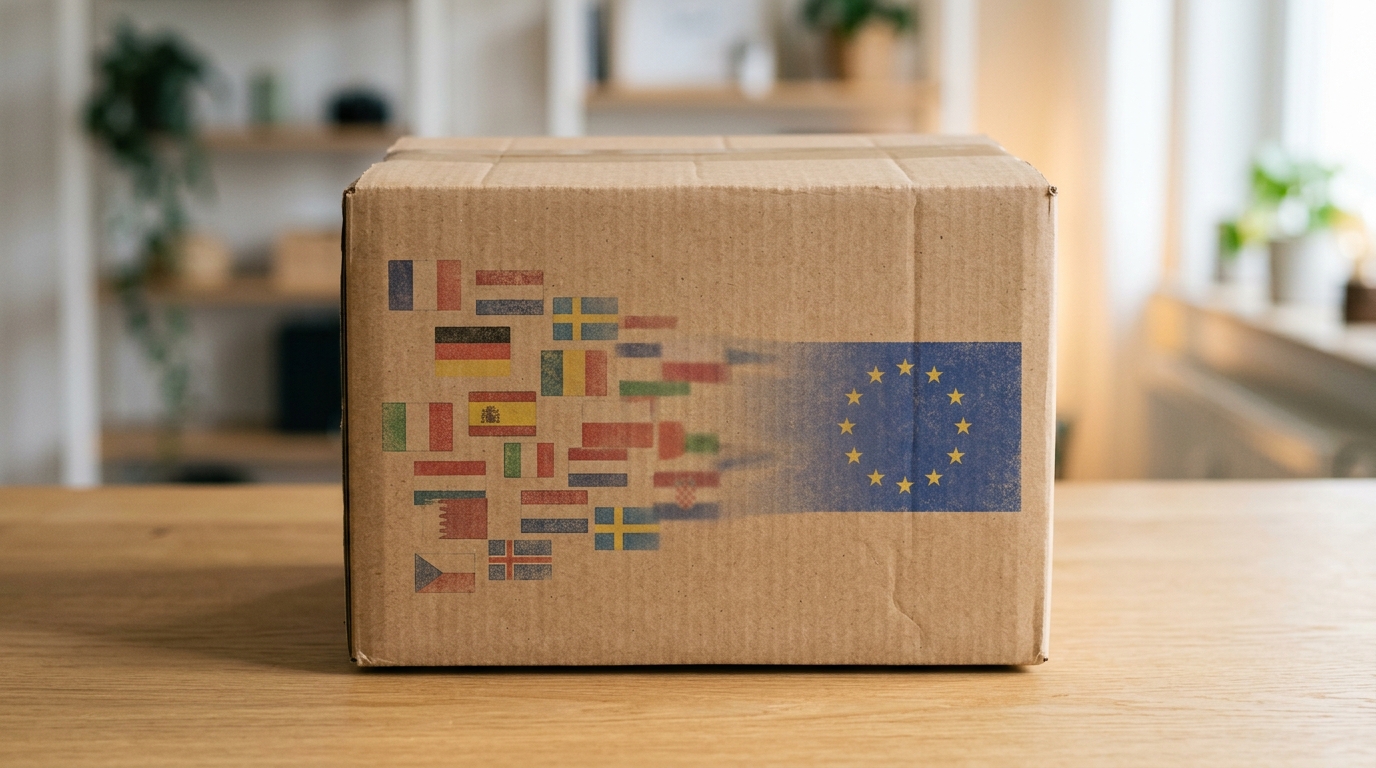
What changes and when: the PPWR harmonises EU rules
Regulation (EU) 2025/40 on packaging and packaging waste (PPWR) establishes a unified technical framework across the European Union starting on 12 August 2026[1]. The regulation entered into force on 11 February 2025 and directly applies in all EU member states, replacing the previous Packaging and Packaging Waste Directive 94/62/EC[2]. For Dutch businesses selling cross-border, this shift brings harmonised product design criteria and substance rules, but it does not create a single administrative desk for European compliance.
The harmonisation focuses primarily on packaging properties, documentation, and environmental safety. From 12 August 2026, packaging placed on the EU market must comply with strict substance restrictions: food-contact packaging may not be placed on the market if it contains PFAS at or above 25 ppb for any individual PFAS, 250 ppb for the sum of targeted PFAS, or 50 ppm for total PFAS including polymeric PFAS[3]. In addition, the regulation sets a phased transition toward mandatory design-for-recycling criteria, with the requirement that all packaging is recyclable applying from 2030[1].
| Regulatory area | Harmonised by PPWR | Status from 12 August 2026 |
|---|---|---|
| Packaging definitions and recyclability criteria | Yes | Unified definitions apply directly across all EU member states |
| Substance limits (e.g. PFAS in food packaging) | Yes | Applies since 12 August 2026; 50 ppm for total PFAS including polymeric PFAS, with tighter limits for targeted PFAS |
| Waste sorting labels on packaging | Yes (phased) | Standardised EU pictograms phase in, replacing national markings |
| EPR producer registration and fee payment | No | National registers and Producer Responsibility Organisations remain separate |
Labelling rules are also slated for EU-wide standardisation under Article 12 of the PPWR. The European Commission is establishing standardised waste sorting pictograms to indicate material composition and proper disposal. The harmonised labelling rolls out from 2028, and once it takes effect it supersedes fragmented national label mandates such as the French Triman logo and Italian environmental markings, reducing the need for country-specific packaging runs. You can explore the broader context in our PPWR overview.
Are you affected? Run the test for your business
The PPWR applies to any business that manufactures, imports, or uses packaging for products distributed within the European Union. Dutch SMEs selling physical goods across borders are directly subject to these rules.
- You sell packaged goods via webshops or marketplaces to end consumers in Germany, Belgium, or other EU countries.
- You import packaged finished products or raw packaging materials from outside the European Union.
- You have packaging manufactured to your own brand specifications or apply your own private label.
- You distribute food-contact products requiring certified compliance with chemical substance limits.
- You use composite or secondary transport materials that must meet verified recyclability criteria.
Small business status does not grant a blanket exemption from the PPWR. Businesses with fewer than 10 employees and turnover under EUR 2 million get more flexible treatment, for example on documentation handled by an EU packaging partner and on reuse rules, but the PPWR obligations themselves remain in force[4]. Every business that introduces packaging into the market must ensure substance compliance and maintain technical documentation, regardless of sales volume. Reviewing your packaging registration readiness ensures your commercial operations stay uninterrupted.
To determine your exact obligations and prepare your product portfolio for upcoming deadlines, contact ClearoSystems for PPWR consultation. Our specialists assess your current supply chain and define the concrete operational adjustments required for your business.
What to do now the dates have passed
Now that the 12 August 2026 application date has passed, catching up requires structured cooperation with your packaging suppliers and logistics partners. Technical compliance has to be verified and documented for packaging already in distribution, not only for what you order next.
- Audit your packaging inventory: catalogue all primary, secondary, and tertiary packaging materials by weight, polymer type, and recyclability.
- Request declarations of conformity: obtain written documentation and test reports from suppliers confirming compliance with substance restrictions, including the Article 5 PFAS thresholds, which have to be evidenced by laboratory reports or substantiated supplier declarations held in the Annex VII technical documentation[5].
- Prepare packaging technical files: compile the necessary data sheets covering material composition, recycled content, and recyclability performance.
- Review artwork and labelling pipelines: plan label redesigns to accommodate upcoming EU harmonised sorting symbols while avoiding obsolete pre-printed inventory.
- Maintain current national registrations: ensure existing contracts with national compliance schemes remain active and up to date.
If you source standard off-the-shelf shipping packaging such as cardboard boxes and filling paper from Dutch distributors, you must ensure your supplier provides valid conformity certificates. If you manufacture custom packaging or commission proprietary branded boxes, your business assumes direct manufacturer obligations to draw up the formal technical dossier and declaration of conformity under the regulation.
What has not changed: national EPR duties remain
A common misconception is that the PPWR creates a single EU-wide license or a central registry that replaces national compliance systems. Extended Producer Responsibility (EPR) remains organised country by country: you still have to check whether you need to register in each country where you use packaging, and in the Netherlands producer responsibility runs through the Besluit beheer verpakkingen 2014 and reporting to Verpact[6], the producer organisation that administers collection and recycling of packaging on behalf of Dutch producers and importers[7].
| Compliance element | Netherlands (Verpact) | Germany (LUCID / Dual Systems) |
|---|---|---|
| Applicable legal basis | Besluit beheer verpakkingen 2014 | PPWR + Verpackungsrecht-Durchführungsgesetz (VerpackDG) |
| Registration portal | Verpact portal (national register) | LUCID packaging register, supervised by the ZSVR |
| Financial threshold for waste fee | 50,000 kg total packaging per year | 0 kg (licensing required from first parcel) |
| Cross-border distance sales requirement | Report national packaging volumes | Mandatory LUCID registration and dual system contract |
In the Netherlands, the 50,000 kg threshold for paying the waste management contribution (afvalbeheersbijdrage) under the Besluit beheer verpakkingen 2014 remains in force today in 2026[6][4]. Dutch companies putting less than 50,000 kg of packaging onto the domestic market do not pay Verpact volume fees. That figure counts all packaging materials together, and above it the first 50,000 kg is still deducted from the invoice basis pro rata per material, so it is an allowance rather than a cliff; deposit and single-use plastic packaging carry no threshold at all. However, when you ship goods to consumers in Germany, German packaging law applies immediately with zero volume exemption. You must register with LUCID and license your packaging with a German dual system from the very first parcel. Complete instructions are outlined in our guide on Verpact registration and our overview of EPR packaging rules.
One Dutch consequence of that unsettled interpretation is already operational: on 22 July 2026 Verpact pressed a "pause button" for shipping, service and primary production packaging, asking companies to keep the responsibilities that applied before 12 August 2026 until the Commission clarifies which party carries the registration, reporting, cost and documentation duties, and warning that a later interpretation could take effect retroactively to 12 August 2026[8]. The pause does not suspend the substance limits, the technical documentation, or your existing Verpact declaration.
National reporting systems remain separate. Exported packaging volumes must be tracked and deducted from your Dutch volume reporting while simultaneously being declared to the respective packaging scheme in the destination country.
Outlook: how the rules develop from here
The regulatory framework will continue to evolve through implementing acts and national legislative adjustments over the coming years. Several operational details remain open and will be clarified as delegated acts are published by the European Commission and transposed into national law.
- PPWR producer registers: under Article 44, harmonised national registers are being established, with full operational integration expected per Verpact from 12 August 2027 at the earliest and initial full reporting expected over 2028, subject to published national instruments.
- Future contribution duties: waste management contributions are set to reach below today's 50,000 kg Dutch threshold from 2028[4], though exact calculation models and fee scales remain undetermined at this stage.
- Recyclability requirements: the detailed design-for-recycling criteria still have to be set in secondary legislation, ahead of the requirement that all packaging be recyclable from 2030[1].
Which obligations apply in each country depends on your exact role in the chain and on where you are established: own manufacture, direct import from non-EU suppliers, sourcing standard packaging from European vendors, or selling own-label products each lead to different legal duties per target market. These distinctions cannot reliably be resolved through a general checklist alone.
To understand your PPWR position today and be on the safe side, contact ClearoSystems for PPWR consultation. Our experts evaluate your specific cross-border setup, assist in securing necessary documentation, and keep your compliance processes aligned as the regulations develop.
Frequently asked questions
- Am I affected by the PPWR changes?
- You are affected if you sell packaged goods into any EU member state, use packaging with recyclability issues, or rely on country-specific labels. Even small enterprises with under EUR 2 million in turnover must ensure their packaging complies with EU-wide substance restrictions, such as the 50 ppm limit for PFAS in food-contact packaging.
- What do I have to do now the date has passed?
- The rules have applied since 12 August 2026, so the substance limits and documentation duties are live now: map your packaging materials against the recyclability requirements and obtain an EU declaration of conformity from your suppliers. Plan your transition away from national waste sorting logos in time for the harmonised EU labels, which roll out from 2028, so you are not left holding obsolete pre-printed stock.
- Do national packaging registrations still apply under the PPWR?
- Yes. The PPWR does not create a central European registration portal or merge Producer Responsibility Organisations. You must maintain your separate national EPR registrations and report your volumes locally, such as to Verpact in the Netherlands or LUCID in Germany.
- Are national thresholds like the Dutch 50,000 kg limit abolished?
- The Dutch 50,000 kg threshold for waste contributions remains in force today. From 2028, the waste contribution is set to apply to businesses using less packaging than that as well. Exactly when and how the current threshold lapses is not settled: until a new Dutch instrument is published, the threshold stands.
- What happens if I do nothing?
- If you fail to adapt your packaging to the harmonised design rules or lack the required declaration of conformity, your products cannot legally be placed on the EU market after the transition dates. Furthermore, neglecting your ongoing national EPR registrations blocks your cross-border sales and exposes you to local enforcement.
- Will European EPR fees converge under the PPWR?
- The regulation aims for harmonised fee modulation based on recyclability, but the actual tariffs will remain set by the national schemes. While contributions are expected to reach businesses below current national thresholds eventually, the exact future amounts and calculation methods remain undetermined.